

Cannes Review: La Gradiva Represents an Impressive Debut of Exceptional Sensitivity
Marine Atlan's La Gradiva—recipient of the Cannes Critics’ Week Grand Prize—starts with a familiar cinematic concept: a school trip abroad for a group of restless teenagers momentarily free from their home constraints. However, the film gradually diverges from traditional genre expectations. The term “teen movie” often brings to mind the loud antics of comedies or horrors—locker-room jokes, teenage angst, slasher film violence—and more recently, the earnest exploration of issues like coming-out stories or school-shooting dramas. Atlan's impressive debut, on the other hand, focuses on something more elusive and harder to depict: the ambiguous psychological space between childhood and adulthood, where identity is still in flux and intimacy evolves hour by hour. The characters are recognizable archetypes—the brooding loner, the sexually adventurous duo, the quiet observer—but they never devolve into stereotypes. The relationships remain fluid, constantly reshaping themselves with the unpredictability of adolescence.
La Gradiva tracks a group of French high-school students on a trip to Naples, Italy, where they are supposed to study Mount Vesuvius and the frescoes of the Villa of the Mysteries. However, the educational aims quickly fade into the background, overshadowed by the complex social interactions among the students. The opening scene establishes the uneasy blend of curiosity, eroticism, and alienation that drives the film: James (Mitia Capellier-Audat) and Angela (Hadya Fofana) engage in sex in a roomette while Toni (Colas Quignard) observes from outside, under the watchful view of Suzanne (Suzanne Gerin). Rather than sensational, this moment is portrayed with an almost anthropological detachment, focusing not on scandal but on the delicate imbalances of desire.
The students confidently perform the behaviors of adulthood. They drink, smoke, experiment with drugs, and casually engage in sexual encounters. These actions seem jarring not due to their unfamiliarity in teenage films, but because Atlan presents them without any moral judgment. Still, La Gradiva also highlights how emotionally unprepared these adolescents truly are. Their teacher, Mme. Mercier (Antonia Buresi), struggles to maintain their focus during lessons, her authority crumbling beneath their chatter and apathy. In a noteworthy scene, the students concoct a grotesque communal punch from various substances, pooling money for whoever dares to drink it. This mixture becomes a miniature representation of adolescence itself: reckless, performative, and somewhat disgusted by its own bravado.
At the heart of La Gradiva is the changing dynamic between Toni and James, which initially embodies the straightforward bond of close male friendship but gradually unveils deeper layers of yearning and separation. Toni secretly observes James with Angela and later uses Grindr to hook up with a local man, an encounter handled with quiet discomfort. Atlan avoids reducing this moment to a mere lesson or trauma narrative; it instead represents a step in Toni’s growing emotional turmoil, with his unreciprocated feelings for James refracting through desire, jealousy, and loneliness. Adolescence in La Gradiva is depicted not as liberation but as an emerging awareness of one's own obscurity to others.
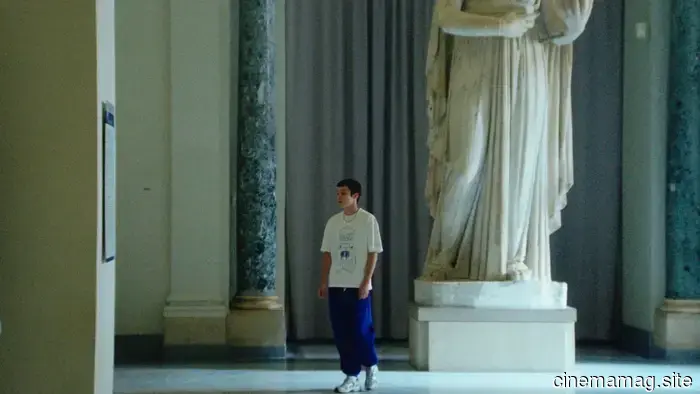
For Toni, this trip to Naples carries the burden of family lore. As a Neapolitan-French teenager, he arrives with a personal stake that his classmates lack. The film begins with faded photos from his family collection, including one allegedly depicting his grandparents in front of a castle in Naples. During the bus ride, Toni shares a family story: his grandmother once worked as a servant there, became pregnant by her employer, and eventually fled after the 1980 earthquake. This narrative lingers over La Gradiva like ancestral folklore, intertwining themes of class, migration, and memory with Toni’s restless quest for belonging. When he ventures out alone in search of the castle, it feels less like an act of rebellion and more like a pilgrimage toward an unstable personal history.
Atlan, a seasoned cinematographer stepping into directing, shows remarkable sensitivity to physical space and texture. Utilizing natural light, vibrant colors, and a richly layered depth of field, she elevates Naples beyond a mere scenic backdrop. The city's worn streets, volcanic landscape, and ancient art give the film a historical weight, as if decades of human desire and tragedy simmer just beneath the surface of the teenagers' seemingly trivial interactions. This contrast is profoundly impactful: dramas of youth unfold against ruins that have outlasted empires, eruptions, and generations of loss.
Music, curated by Hippocampus, adds another vital layer to La Gradiva's emotional landscape. The eclectic soundtrack never feels unnecessary or overwhelming. Particularly haunting are the trumpet interpretations of Erik Satie's compositions, whose poignant subtlety mirrors the film’s emotional tone: tender, questing, and perpetually unresolved.
What sets La Gradiva apart is the depth behind its seemingly free-flowing structure. In several quietly captivating scenes, the students

Other articles
 Preview of Comic Book – Doomquest #1
Marvel Comics is set to release Doomquest #1 this Wednesday, and you can check out a preview with the official sneak peek below… Doctor Victor Von Doom is an exceptional scientist, a peerless sorcerer, an…
Preview of Comic Book – Doomquest #1
Marvel Comics is set to release Doomquest #1 this Wednesday, and you can check out a preview with the official sneak peek below… Doctor Victor Von Doom is an exceptional scientist, a peerless sorcerer, an…
 Top 5 Online Casinos in Australia for Real Money - A Comparison of New Casino Sites and Bonus Offers -
In 2026, Australian players looking for the top real money online casinos are placing a higher emphasis on secure payouts, reliable banking options, and high-quality gaming experiences.
Top 5 Online Casinos in Australia for Real Money - A Comparison of New Casino Sites and Bonus Offers -
In 2026, Australian players looking for the top real money online casinos are placing a higher emphasis on secure payouts, reliable banking options, and high-quality gaming experiences.
 Cannes Review: Lukas Dhont Places a Queer Love Story in the Trenches of WWI with Coward
Cinema has immersed audiences in the trenches of World War I so frequently that viewers may have developed sensory memories of a gut-wrenching fear, with screams swallowed by sudden blasts and ears buzzing. While it’s all fictional, the empathy generated by film is ideally designed for these immersive experiences from a secure distance.
Cannes Review: Lukas Dhont Places a Queer Love Story in the Trenches of WWI with Coward
Cinema has immersed audiences in the trenches of World War I so frequently that viewers may have developed sensory memories of a gut-wrenching fear, with screams swallowed by sudden blasts and ears buzzing. While it’s all fictional, the empathy generated by film is ideally designed for these immersive experiences from a secure distance.
 Top Online Pokies Websites in Australia for 2026: 5 Leading Aussie Casinos Featuring PayID Pokies and Jackpots - MovieMaker
Australia boasts one of the largest pokies communities globally, with players continually on the lookout for the top online pokies sites, largest jackpots, and
Top Online Pokies Websites in Australia for 2026: 5 Leading Aussie Casinos Featuring PayID Pokies and Jackpots - MovieMaker
Australia boasts one of the largest pokies communities globally, with players continually on the lookout for the top online pokies sites, largest jackpots, and
 Cannes Review: La Gradiva is an Impressive Debut of Exceptional Sensitivity
Marine Atlan's La Gradiva—recipient of the Grand Prize at Cannes Critics’ Week—starts from a recognizable cinematic concept: a group of restless teenagers on a school trip abroad, momentarily liberated from the watchful eyes of home. However, the film gradually diverges from the typical constraints of the genre. The term “teen movie” often brings to mind the loud structure of
Cannes Review: La Gradiva is an Impressive Debut of Exceptional Sensitivity
Marine Atlan's La Gradiva—recipient of the Grand Prize at Cannes Critics’ Week—starts from a recognizable cinematic concept: a group of restless teenagers on a school trip abroad, momentarily liberated from the watchful eyes of home. However, the film gradually diverges from the typical constraints of the genre. The term “teen movie” often brings to mind the loud structure of
.jpg) 4K Ultra HD Evaluation – Speed Racer (2008)
Speed Racer, 2008. Directed by The Wachowskis. Featuring Emile Hirsch, Christina Ricci, John Goodman, Susan Sarandon, Matthew Fox, Benno Fürmann, Hiroyuki Sanada, Rain, and Richard Roundtree. SYNOPSIS:…
4K Ultra HD Evaluation – Speed Racer (2008)
Speed Racer, 2008. Directed by The Wachowskis. Featuring Emile Hirsch, Christina Ricci, John Goodman, Susan Sarandon, Matthew Fox, Benno Fürmann, Hiroyuki Sanada, Rain, and Richard Roundtree. SYNOPSIS:…
Cannes Review: La Gradiva Represents an Impressive Debut of Exceptional Sensitivity
Marine Atlan's La Gradiva—recipient of the Grand Prize at Cannes Critics’ Week—starts with a well-known cinematic concept: a group of restless teenagers on a school trip abroad, enjoying a brief escape from the watchful eyes of home. However, the film gradually detaches itself from the typical expectations of the genre. The term "teen movie" often brings to mind the chaotic structure of