
Cannes Review: La Gradiva is an Impressive Debut of Exceptional Sensitivity
Marine Atlan's La Gradiva—recipient of the Cannes Critics' Week Grand Prize—starts with a familiar cinematic scenario: a school trip abroad for a bus full of restless teenagers temporarily escaping the watchfulness of home. However, the film gradually moves beyond conventional genre confines. The term “teen movie” often evokes the loud structure of comedy or horror—locker-room antics, hormonal anxiety, slasher bloodshed—and more recently, the serious themes of coming-out stories or school shooting dramas. Atlan's impressive debut, on the other hand, engages with a more elusive and challenging subject: the unclear psychological space between childhood and adulthood, where identity remains tentative and intimacy changes frequently. Although her characters embody familiar archetypes—the brooding outcast, the sexually daring couple, the reserved observer—they never fully solidify into caricatures. The dynamics stay fluid, continually reshaping themselves in sync with the unpredictability of adolescence.
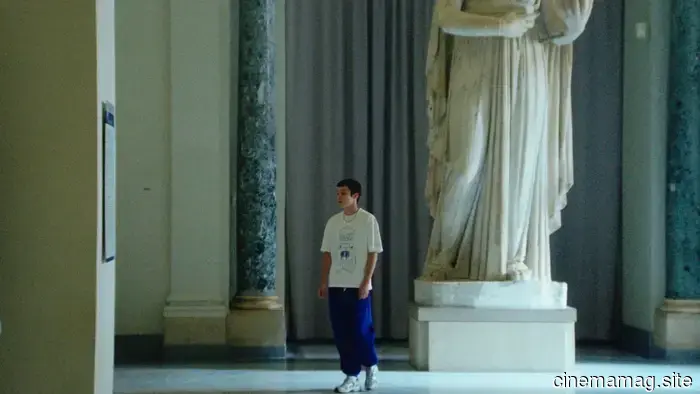
La Gradiva follows a group of French high school students on a class trip to Naples, Italy, where they are supposed to study Mount Vesuvius and the frescoes of the Villa of the Mysteries. The educational aspect quickly fades into the background, overshadowed by the charged social environment of the students themselves. The opening scene establishes the uneasy blend of curiosity, eroticism, and alienation that fuels the film: James (Mitia Capellier-Audat) and Angela (Hadya Fofana) engage in sex within a roomette while Toni (Colas Quignard) observes from outside, under the silent watch of Suzanne (Suzanne Gerin). This moment lacks the sensationalism one might expect from modern youth films. Instead, Atlan observes the scene with almost anthropological detachment, focusing less on scandal and more on the delicate imbalances of desire.
The students display the behaviors associated with adulthood with surprising confidence. They drink, smoke, use drugs, and casually engage in sexual activity—actions that feel shocking not because they are new to films about teenagers, but because Atlan depicts them without moral judgment. However, La Gradiva equally highlights how emotionally unprepared these adolescents are. Their teacher, Mme. Mercier (Antonia Buresi), struggles to keep their attention during lectures, her authority eroding under a wave of chatter and lethargy. In one revealing moment, the students create a grotesque communal punch from alcohol, oranges, peppers, cigarette butts, and whatever else they can find, pooling money for anyone willing to drink it. This concoction becomes a miniature representation of adolescence: reckless, performative, and somewhat disgusted with its own bravado.
At the heart of La Gradiva lies the evolving relationship between Toni and James, which starts with the simple dynamic of inseparable male friendship but gradually unveils deeper currents of yearning and distance. Toni secretly observes James with Angela, and later connects with a local adult man through Grindr, an encounter presented with quiet discomfort. Atlan avoids reducing this moment to a lesson or traumatic narrative. Instead, it marks an increment in Toni’s growing emotional confusion, his unreciprocated feelings for James refracted through desire, jealousy, and isolation. Adolescence in La Gradiva does not appear as liberation but as a dawning realization of one's own opacity to others.
For Toni, this trip to Naples is also laden with family lore. As a Neapolitan-French teenager, he arrives with a personal stake that his classmates do not share. The film opens with faded photos from his family archive, including one purportedly showing his grandparents in front of a castle in Naples. During the bus ride, Toni recounts a family tale: his grandmother worked there as a servant, became pregnant by her employer, and eventually fled after the earthquake of 1980. This story looms over La Gradiva like an inherited myth, intertwining themes of class, migration, and memory with Toni’s restless quest for belonging. When he eventually ventures alone to find the castle, it feels less like an act of rebellion and more like a pilgrimage towards a tenuous personal history.
As a veteran cinematographer making her directorial debut, Atlan shows remarkable sensitivity to physical space and texture. Utilizing natural light, rich colors, and a layered depth of field, she transforms Naples into more than just a scenic backdrop. The city’s weathered streets, volcanic landscape, and ancient art contribute to the film’s sense of history, as if centuries of human desire and disaster are just beneath the surface of these teenagers’ seemingly mundane interactions. This contrast proves quietly devastating: adolescent dramas unfold against ruins that have withstood empires, eruptions, and generations of loss.
Music, overseen by Hippocampus, adds another crucial layer to La Gradiva's emotional landscape. The diverse selections never feel superfluous or overly intrusive. Particularly haunting are the trumpet interpretations of compositions by Erik Satie, whose poignant restraint reflects the film’s emotional tone: tender, exploratory, and

Other articles
 Cannes Review: Lukas Dhont Places a Queer Love Story in the Trenches of WWI with Coward
Cinema has immersed audiences in the trenches of World War I so frequently that viewers may have developed sensory memories of a gut-wrenching fear, with screams swallowed by sudden blasts and ears buzzing. While it’s all fictional, the empathy generated by film is ideally designed for these immersive experiences from a secure distance.
Cannes Review: Lukas Dhont Places a Queer Love Story in the Trenches of WWI with Coward
Cinema has immersed audiences in the trenches of World War I so frequently that viewers may have developed sensory memories of a gut-wrenching fear, with screams swallowed by sudden blasts and ears buzzing. While it’s all fictional, the empathy generated by film is ideally designed for these immersive experiences from a secure distance.
 Comic Book Sneak Peek – Superman: Father of Tomorrow #1
DC Comics is set to launch Superman: Father of Tomorrow #1 on Wednesday, and we have an official preview of the issue for you below; take a look… In a distant part of the universe, a planet detonates. A lo…
Comic Book Sneak Peek – Superman: Father of Tomorrow #1
DC Comics is set to launch Superman: Father of Tomorrow #1 on Wednesday, and we have an official preview of the issue for you below; take a look… In a distant part of the universe, a planet detonates. A lo…
 James Bond kicks off with the launch trailer for 007 First Light.
As anticipation rises for the launch of 007 First Light on May 27th, IO Interactive has unveiled an exhilarating, action-filled launch trailer (see below). The trailer gives a glimpse into the battles t…
James Bond kicks off with the launch trailer for 007 First Light.
As anticipation rises for the launch of 007 First Light on May 27th, IO Interactive has unveiled an exhilarating, action-filled launch trailer (see below). The trailer gives a glimpse into the battles t…
 5 Best Offshore Casinos in the USA 2026 | Top Offshore Casinos for US Players - MovieMaker Magazine
Offshore casinos remain appealing to US players by providing bigger bonuses, quicker crypto payouts, a wider variety of games, and fewer limitations than many.
5 Best Offshore Casinos in the USA 2026 | Top Offshore Casinos for US Players - MovieMaker Magazine
Offshore casinos remain appealing to US players by providing bigger bonuses, quicker crypto payouts, a wider variety of games, and fewer limitations than many.
 Cannes Review: La Gradiva Represents an Impressive Debut of Exceptional Sensitivity
Marine Atlan's La Gradiva—recipient of the Grand Prize at Cannes Critics’ Week—starts with a well-known cinematic concept: a group of restless teenagers on a school trip abroad, enjoying a brief escape from the watchful eyes of home. However, the film gradually detaches itself from the typical expectations of the genre. The term "teen movie" often brings to mind the chaotic structure of
Cannes Review: La Gradiva Represents an Impressive Debut of Exceptional Sensitivity
Marine Atlan's La Gradiva—recipient of the Grand Prize at Cannes Critics’ Week—starts with a well-known cinematic concept: a group of restless teenagers on a school trip abroad, enjoying a brief escape from the watchful eyes of home. However, the film gradually detaches itself from the typical expectations of the genre. The term "teen movie" often brings to mind the chaotic structure of
 Preview of Comic Book – Doomquest #1
Marvel Comics is set to release Doomquest #1 this Wednesday, and you can check out a preview with the official sneak peek below… Doctor Victor Von Doom is an exceptional scientist, a peerless sorcerer, an…
Preview of Comic Book – Doomquest #1
Marvel Comics is set to release Doomquest #1 this Wednesday, and you can check out a preview with the official sneak peek below… Doctor Victor Von Doom is an exceptional scientist, a peerless sorcerer, an…
Cannes Review: La Gradiva is an Impressive Debut of Exceptional Sensitivity
Marine Atlan's La Gradiva—recipient of the Grand Prize at Cannes Critics’ Week—starts from a recognizable cinematic concept: a group of restless teenagers on a school trip abroad, momentarily liberated from the watchful eyes of home. However, the film gradually diverges from the typical constraints of the genre. The term “teen movie” often brings to mind the loud structure of