
Cannes Review: Radu Jude’s Diary of a Chambermaid Offers a Humorous, Slightly Meta Perspective on Mirbeau
Radu Jude has been continually producing features since his international breakthrough with Aferim! in 2015, and his selection is nearly impossible to categorize. His films span a wide range, including a three-hour documentary on the first massacre of Jews in Romania during WWII, a hilarious comedy about a production assistant creating a safety video in Bucharest, an absurdist meta-interpretation of Dracula (not actually about Dracula), a dramedy centered on a Transylvanian bailiff, and a sharp critique of contemporary Romanian conservatism titled Bad Luck Banging or Loony Porn (which some may argue is his finest work). Diary of a Chambermaid is his twelfth film in eleven years, not accounting for the shorts and segments for various projects he’s directed during that time (or for his minor role in Arthur Harari’s The Unknown, which is part of this year’s competition).
This film is loosely inspired by Octave Mirbeau’s French novel from 1900, which has been adapted for the screen three times: once by Jean Renoir in the 1940s, again by Luis Buñuel in the 1960s, and finally by Benoît Jacquot in 2015. Those adaptations provide more or less iterative interpretations of the story, which follows a clever servant named Célestine who plots her way to wealth. Jude’s version is much more meta and does not engage with Mirbeau’s storyline at all. In fact, its title serves more as a playful nod than a reflection of the film’s content. However, it is indeed focused on the diary of a maid working in Paris.
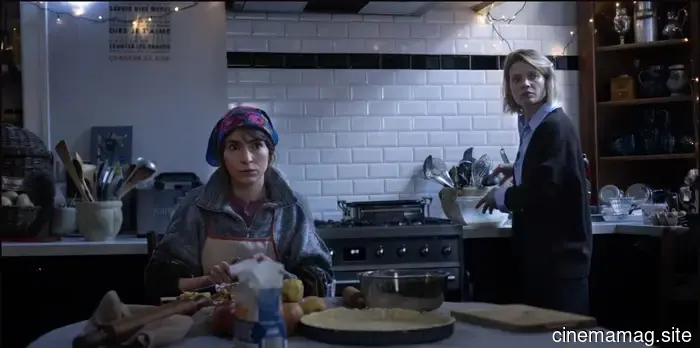
The protagonist is Gianina (Ana Dumitrascu), a Romanian live-in maid for Marguerite (Mélanie Thierry) and the Asterix- and Obelix-despising Pierre Donnadieu (a hilarious Vincent Macaigne), a wealthy French couple with a child. Their affluence and immersion in bourgeois matters leave them oblivious to Gianina’s life and needs. They believe they treat her well by speaking kindly, keeping their distance, and pretending to be accommodating; in reality, they always have their way. They fail to recognize Gianina’s humanity, seeing her more as a cleaning, child-rearing android who is perpetually available, even asking her absurd questions like, “Should Ukraine capitulate to Russia?” in front of a dinner party full of highly opinionated guests from various political backgrounds (true to Jude’s style, the conversation ends comically with a discussion about the attractiveness of Zelensky).
Gianina excels in her role, yet she's remarkably timid, which lets the Donnadieus take advantage of her. If she were to assert herself or claim her time, she might risk being fired, but that doesn’t appear likely. There seems to be ample opportunity for self-respect, but it would hardly matter if she didn’t have a five-year-old daughter in Romania who misses her dearly. Throughout the timeline of Diary (from September to December), their relationship is limited to FaceTime calls and photos, causing Gianina's heart to ache for her only child. She assures her daughter she will return on certain dates, but minor inconveniences for the Donnadieus constantly delay her departure.
The film unfolds day by day in Gianina's life, reminiscent of reading her diary, with sudden cuts that play like punchlines at the end of most segments, each beginning with a date—typically two to four days after the last, barring some longer or shorter jumps. In the midst of her mundane tasks, she’s persuaded by the somewhat less oblivious Marguerite to participate in a play—a stage adaptation of The Diary of a Chambermaid. The experimental, minority-focused theatre company producing it (led by Ilinca Manolache from Do Not Expect Too Much from the End of the World) adopts a minimalist style, casting non-actor Gianina as the maid and another non-actor for every other role. Their quirky, drawn-out rendition resembles what we might expect from Jude if he aimed for a faithful adaptation while still infusing his outrageous humor.
Lengthy, static single takes comically display Gianina's lack of acting talent (a testament to Dumitrascu’s excellent performance) and hint at the ineptitude of the company’s version of the play. Additionally, they require her to perform completely naked while bluntly informing her that they don't have the budget for an intimacy coordinator, something Gianina should obviously contest but does not.
At 94 minutes and filled with humor, Diary of a Chambermaid moves quickly, yet it eventually grows repetitive and amounts to little more than a collection of amusing scenes. Had Jude invested more time or creative energy—or perhaps woven in some drama beyond the final act (which feels misplaced at that juncture)—it could have been outstanding. However, the unattractive, hyper-digital, hastily put-together iPhone cinemat
Other articles
 Cannes Review: La Bola Negra Gives the Impression of a Grand, Forgotten Novel
If storytelling in the 19th and 20th centuries was characterized by magnificent literature, the 21st century centers around cinema. We read less and consume more visual content; as a result, films have taken the place of expansive narratives that intertwine different timelines and characters. A recent example of this is the Cannes sensation La Bola Negra (also known as The Black Ball), an exceptionally ambitious endeavor—drawn from historical influences.
Cannes Review: La Bola Negra Gives the Impression of a Grand, Forgotten Novel
If storytelling in the 19th and 20th centuries was characterized by magnificent literature, the 21st century centers around cinema. We read less and consume more visual content; as a result, films have taken the place of expansive narratives that intertwine different timelines and characters. A recent example of this is the Cannes sensation La Bola Negra (also known as The Black Ball), an exceptionally ambitious endeavor—drawn from historical influences.
 Cannes Review: Low Expectations Is a Skilled and Bittersweet First Film
From A Star is Born to Vox Lux to Inside Llewyn Davis, the film industry is filled with narratives of disillusioned musicians who either shone too brightly or fell short of their aspirations. The new film Low Expectations offers a bittersweet story from Oslo that comes in the wake of Joachim Trier, that dependable director.
Cannes Review: Low Expectations Is a Skilled and Bittersweet First Film
From A Star is Born to Vox Lux to Inside Llewyn Davis, the film industry is filled with narratives of disillusioned musicians who either shone too brightly or fell short of their aspirations. The new film Low Expectations offers a bittersweet story from Oslo that comes in the wake of Joachim Trier, that dependable director.
 Top Online Pokies Websites in Australia for 2026: 5 Leading Aussie Casinos Featuring PayID Pokies and Jackpots - MovieMaker
Australia boasts one of the largest pokies communities globally, with players continually on the lookout for the top online pokies sites, largest jackpots, and
Top Online Pokies Websites in Australia for 2026: 5 Leading Aussie Casinos Featuring PayID Pokies and Jackpots - MovieMaker
Australia boasts one of the largest pokies communities globally, with players continually on the lookout for the top online pokies sites, largest jackpots, and
 Cannes Review: La Bola Negra Appears to Be an Epic, Forgotten Novel
If storytelling in the 19th and 20th centuries was characterized by grand literature, the 21st century is marked by cinema. We read less and consume more visual content; as a result, films have taken the place of expansive narratives that intertwine multiple timelines and characters. A recent example of this is the Cannes debut La Bola Negra (also known as The Black Ball), a genuinely ambitious undertaking—drawn from historical events.
Cannes Review: La Bola Negra Appears to Be an Epic, Forgotten Novel
If storytelling in the 19th and 20th centuries was characterized by grand literature, the 21st century is marked by cinema. We read less and consume more visual content; as a result, films have taken the place of expansive narratives that intertwine multiple timelines and characters. A recent example of this is the Cannes debut La Bola Negra (also known as The Black Ball), a genuinely ambitious undertaking—drawn from historical events.
Cannes Review: Radu Jude’s Diary of a Chambermaid Offers a Humorous, Slightly Meta Perspective on Mirbeau
Radu Jude has been consistently delivering feature films since his international breakthrough with Aferim! in 2015, and his style is quite hard to categorize. His works vary from an extensive three-hour documentary about the first massacre of Jews in Romania during World War II to a wild comedy centered on a production assistant creating a safety video in Bucharest.