
The Screenwriter's Handbook for 'The Rock': Transforming an Athlete's Image into an Action Series
A practical guide aimed at screenwriters, producers, and directors focused on transforming an athlete’s public image—similar to the “The Rock” persona—into long-term action-franchise intellectual property (IP). This approach employs valuation logic, risk management, and market indicators already respected by studios.
**Persona as IP**
A profitable persona acts like pre-sold IP: it comes with audience expectations, established tones, and a repeatable promise that can be repackaged across sequels, spinoffs, and related formats. Screenwriters should aim not to replicate a celebrity but to interpret public traits into narrative elements understandable to buyers: character rules, moral clarity, dynamic pacing, and a distinctive emotional payoff. For producers, persona-driven IP minimizes uncertainty by reducing unknowns in marketing and performance forecasting. For directors, it clarifies the camera's role: to capture dependability while preserving spontaneity. The goal is to achieve commercial predictability while maintaining a sense of cinematic freshness.
**“The Rock” Archetype as a Valuable Studio Asset**
Studios prefer archetypes that immediately convey the film’s experience, and the “The Rock” archetype is designed for such clarity. It indicates competence under pressure, high physical energy, and an ethical core that is relatable across demographics and international markets. This simplifies the greenlight process, making pitches easier to comprehend and position globally. The archetype also thrives in action-comedy blends where physical stakes and humor can coexist seamlessly. In franchise terms, it functions like an operating system: consistent inputs yield consistent audience reactions, regardless of changes in plots, settings, or villains.
**The Foundation of Commercial Reliability**
Commercial reliability isn’t the same as fame; it’s the repeatable trust of the audience based on observable traits. Attributes such as energy levels, physical believability, protectiveness towards allies, and a clear moral compass contribute to this trust. The “The Rock” persona has a structural advantage, as physicality instantly conveys competence, allowing scripts to reduce exposition and quicken pacing. This efficiency holds financial value: fewer scenes are necessary to establish credibility and momentum increases swiftly. Reliability also extends beyond the screen since personas that act predictably in public are easier to insure, schedule, and franchise across multiple production cycles.
**Franchise IP Design – Aligning Persona with Sequel Frameworks**
A successful action franchise relies on a repeatable structure: recognizable mission elements, escalating scenes, varying antagonists, and emotional continuity that doesn't demand prior knowledge from the audience. Persona provides the connective tissue that ensures these elements remain cohesive across installments. Writers can create narrative "slots" that the persona naturally occupies, such as the reluctant hero, the unstoppable savior, or the steadfast enforcer amidst chaos. Producers can ensure longevity by weaving in team dynamics, legacy narratives, or mythic themes without undermining the core impression. Thus, the persona becomes the franchise’s stabilizing core.
**Measuring Talent Valuation**
Filmmaking is creative, yet greenlight decisions are often based on risk analysis. Objective indicators help executives differentiate between volatility and reliability, particularly when budgets and marketing expenses reach nine figures. It’s beneficial to view a persona as an asset with measurable stability. Industry analysis provides blunt signals of this confidence; for instance, in 2016, Forbes named Dwayne Johnson the highest-paid actor, reporting earnings of $64.5 million, which reflects how the market rewards perceived reliability and output volume. While these figures don’t guarantee box-office success, they illustrate how financiers prioritize predictability when allocating capital.
Screenwriters often lack straightforward numerical assessments of "worth," but sports markets provide such data regularly. A player’s fantasy football auction values exhibit how markets evaluate talent amid uncertainty by considering projected performance, role security, injury risk, schedule context, and alternatives. This reference serves as an analytical approach rather than a promotion, demonstrating how complex indicators can be distilled into a single, trackable price. The clear lesson for filmmakers is to adopt valuation frameworks that provide clarity regarding risk, potential upside, and sustainability.
**From Sports Metric to Genre Archetype**
When reliability is regarded as a marketable asset, the creative challenge shifts to conveying that reliability within genre expectations. Action franchises require audience assurance: the hero must seem capable, the stakes must feel justified, and the emotional tone must be clear amidst spectacle. When a persona exhibits a high performance baseline, scripts can lean into that stability by emphasizing competence early on and expanding scale instead of moral ambiguity. This creates a genre archetype the audience intuitively grasps, with complexity arising from situations rather than character inconsistencies.
**Case Example – Budget-to-Gross Evidence**
Studios meticulously scrutinize audience responses when a dependable persona is integrated into established franchises. A well-cited success is Fast Five (2011), which had a reported budget of $125 million and earned around $626.1 million at the global box office. The importance of these figures lies in the franchise's growth following the introduction of a fresh and
Other articles
 The Primate featurette offers a behind-the-scenes look at the frightening chaos involving monkeys.
Paramount Pictures has released a behind-the-scenes featurette for their upcoming film Primate, which revolves around the tale of a family's pet chimp that contracts rabies and begins to…
The Primate featurette offers a behind-the-scenes look at the frightening chaos involving monkeys.
Paramount Pictures has released a behind-the-scenes featurette for their upcoming film Primate, which revolves around the tale of a family's pet chimp that contracts rabies and begins to…
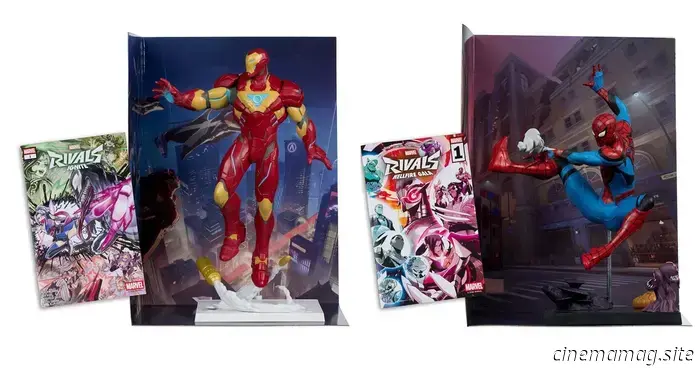 Spider-Man and Iron Man are added to McFarlane Toys' Marvel Rivals collection with collectible figures.
After reviewing the Hulk and Venom figures last month, McFarlane Toys has now introduced two new collectibles based on the popular PVP shooter Marvel Rivals, featuring sixth scale figurines of Spider-Man…
Spider-Man and Iron Man are added to McFarlane Toys' Marvel Rivals collection with collectible figures.
After reviewing the Hulk and Venom figures last month, McFarlane Toys has now introduced two new collectibles based on the popular PVP shooter Marvel Rivals, featuring sixth scale figurines of Spider-Man…
.png) 10 лучших биткоин-казино в России (2026 год)
Не уверены, как подобрать идеальное биткоин-казино? Мы собрали нейтральные и беспристрастные обзоры, которые помогут вам легко сравнить крипто-казино по ключевым параметрам.
10 лучших биткоин-казино в России (2026 год)
Не уверены, как подобрать идеальное биткоин-казино? Мы собрали нейтральные и беспристрастные обзоры, которые помогут вам легко сравнить крипто-казино по ключевым параметрам.
 The Overlooked Champions of Film: The Role of Propsmen in Creating Cinematic Wonders - MovieMaker Magazine
When you view your favorite film, the first elements that draw your focus are usually the actors, the plot, or the impressive visual effects. It is uncommon to
The Overlooked Champions of Film: The Role of Propsmen in Creating Cinematic Wonders - MovieMaker Magazine
When you view your favorite film, the first elements that draw your focus are usually the actors, the plot, or the impressive visual effects. It is uncommon to
.jpg) Film Review – Marty Supreme (2025)
Marty Supreme, 2025. Directed by Josh Safdie. Featuring Timothée Chalamet, Gwyneth Paltrow, Odessa A’zion, Kevin O’Leary, Tyler Okonma, Abel Ferrara, Fran Drescher, Emory Cohen, Penn Jillette...
Film Review – Marty Supreme (2025)
Marty Supreme, 2025. Directed by Josh Safdie. Featuring Timothée Chalamet, Gwyneth Paltrow, Odessa A’zion, Kevin O’Leary, Tyler Okonma, Abel Ferrara, Fran Drescher, Emory Cohen, Penn Jillette...
 Exclusive Interview – Fiona Crombie, Production Designer for Hamnet
Chris Connor speaks with Fiona Crombie, the production designer for Hamnet. Adapted from Maggie O’Farrell’s acclaimed 2020 novel, Hamnet has become a significant contender for this award.
Exclusive Interview – Fiona Crombie, Production Designer for Hamnet
Chris Connor speaks with Fiona Crombie, the production designer for Hamnet. Adapted from Maggie O’Farrell’s acclaimed 2020 novel, Hamnet has become a significant contender for this award.
The Screenwriter's Handbook for 'The Rock': Transforming an Athlete's Image into an Action Series
A pragmatic, business-oriented resource for screenwriters, producers, and directors aiming to transform an athlete's public image—similar to that of Dwayne.