

Everyone to Kenmure Street: Could a 2021 Scottish Protest Serve as a Model for Halting ICE?
The new Sundance documentary Everybody to Kenmure Street provides a detailed account of a protest that took place in 2021 in Glasgow, Scotland, opposing immigration officials who attempted to detain two Sikh men from their community. This gathering occurred in Pollokshields, the city’s most diverse neighborhood, where residents quickly mobilized to protect their neighbors.
The film is especially timely, as it debuted last week just four days after the death of Alex Pretti due to ICE actions, and 21 days following the killing of Renee Good. These incidents have sparked significant discussion nationwide about the aggressive tactics of ICE agents executing searches in the name of national security, creating tensions with both immigrants and U.S. citizens.
During the Pollokshields protest, officials from the Home Office, the UK’s equivalent of the Department of Homeland Security, detained the two men on the first day of Eid al-Fitr, a significant Muslim holiday signaling the end of Ramadan's dawn-to-dusk fasting.
Using social media, the local community swiftly organized demonstrations. One protester, known only as Van Man, placed himself underneath the van containing the detained Sikh men, effectively blocking authorities from removing them.
While local police attempted to control the protest, they were heavily outnumbered. And—if you want to avoid spoilers, don’t read this next part—the Home Office officials ended up releasing the two men.
Director Felipe Bustos Sierra collected thousands of hours of phone footage to create the film but aimed to avoid a detached perspective. To fully grasp the events of the Eid raid on May 13, 2021, he took long walks with many involved, trying to comprehend the logistics and emotional dynamics of the protest.
Bustos Sierra has a personal understanding of oppressive regimes—his father was a Chilean journalist forced into exile in Belgium after Augusto Pinochet established a violent dictatorship in 1973. Now a Chilean-Belgian filmmaker, he resides in Scotland.
Recently, Everybody to Kenmure Street received Sundance’s World Cinema Documentary Special Jury Award for Civil Resistance. We discussed with Bustos Sierra the similarities and differences between the Kenmure Street protest and anti-ICE demonstrations, the historical context of the film, and some notable celebrity appearances.
Everybody To Kenmure Street Director Felipe Bustos Sierra on ICE, the Home Office, and ‘All of Us’
MovieMaker: Do you think the approach of overwhelming immigration officials with numbers could be an effective strategy for protesters in the United States?
Felipe Bustos Sierra: There’s a choir song featured during a pivotal moment of the protest. It’s written by Barry Burns (of Mogwai) and sung by one of Scotland’s oldest Gaelic choirs. They repeat two lines in Urdu and Gaelic: “We go together” and “It will take all of us.”
I believe achieving critical mass is essential, along with the ability to record and share information quickly to draw in more participants.
MovieMaker: I noticed the Scottish police appeared remarkably calm compared to the ICE agents in the U.S. who recently shot Renee Good and Alex Pretti. Is this a cultural difference or a training issue? Ultimately, the police decided to release the men to de-escalate the situation.
Felipe Bustos Sierra: Compared to ICE in the U.S., their calmness still seemed like an overreaction and didn’t align with the circumstances. The main difference is that UK police are unarmed, which removes the immediate potential for violence that is often present in the U.S.
There wasn’t much collaboration from police or government agencies in making this film. I would have liked to uncover more about the power dynamics that day and who ultimately made the decision to end the detention. I suspect that overtime costs may have played a role, as an extended operation could have significantly inflated the budget and been challenging to justify publicly.
We may learn more in the future, but after nearly five years of work, it didn’t seem crucial for our film, which focuses more on the sensory experience of participating in a protest.
MovieMaker: I appreciated the film's unexpected exploration of how Glasgow and the UK benefited from slavery. Why did you decide to include this context in a documentary about a protest against immigration enforcement?
Felipe Bustos Sierra: Many participants were attending their first protest that day and recognized the injustices occurring in their neighborhood. A common theme in our discussions was the realization of injustice in their own community and the frustration that nothing had previously been done about it.
In a sense, it doesn’t matter what motivated them to protest; it was crucial that they showed up. However, that notion is misleading—people have been trying to address these issues for decades, especially in Glasgow’s southside.
The city experienced rapid and dramatic benefits from the Transatlantic slave trade and its legacies, resulting in a new social hierarchy and significant injustices. Over generations, some individuals have consistently recognized these wrongs and taken action, whether related to universal suffrage, emancipation
Other articles
 Hasbro has introduced new action figures for Transformers: Age of the Primes.
Hasbro has introduced a fresh lineup of action figures for Transformers: Age of the Primes, featuring a Voyager Class The Thirteen Nexus Prime and Deluxe Class figures for Smokescreen, Swerve, Ratchet, and others.
Hasbro has introduced new action figures for Transformers: Age of the Primes.
Hasbro has introduced a fresh lineup of action figures for Transformers: Age of the Primes, featuring a Voyager Class The Thirteen Nexus Prime and Deluxe Class figures for Smokescreen, Swerve, Ratchet, and others.
 Trailer for the Netflix sci-fi action thriller "War Machine," featuring Alan Ritchson.
Netflix has released a poster and trailer for the upcoming sci-fi action thriller War Machine. Alan Ritchson (Reacher) plays a combat engineer tasked with leading his team in a battle for survival when they…
Trailer for the Netflix sci-fi action thriller "War Machine," featuring Alan Ritchson.
Netflix has released a poster and trailer for the upcoming sci-fi action thriller War Machine. Alan Ritchson (Reacher) plays a combat engineer tasked with leading his team in a battle for survival when they…
 Netflix releases trailer for BAKI-DOU: The Invincible Samurai.
Prior to the release of BAKI-DOU: The Invincible Samurai on Netflix later this month, the streaming service has unveiled a trailer, poster, and images for the upcoming anime series inspired by Keisuke Itagaki…
Netflix releases trailer for BAKI-DOU: The Invincible Samurai.
Prior to the release of BAKI-DOU: The Invincible Samurai on Netflix later this month, the streaming service has unveiled a trailer, poster, and images for the upcoming anime series inspired by Keisuke Itagaki…
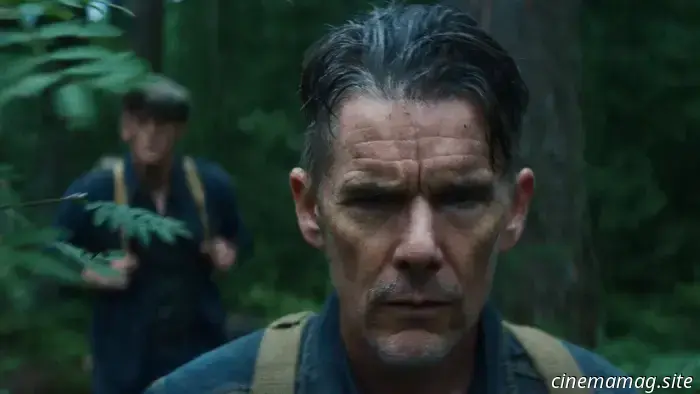 Sundance Review: Ethan Hawke Shines in The Weight
Gold serves as a perfect symbol for greed. Its luster is captivating, it's substantial in weight, it lacks depth, and it is acquired through the efforts of others. This work is shouldered by the oppressed and the desperate, while those who profit from it remain comfortably distanced. Presently, gold prices have reached a record high, reflecting the enduring nature of its allure.
Sundance Review: Ethan Hawke Shines in The Weight
Gold serves as a perfect symbol for greed. Its luster is captivating, it's substantial in weight, it lacks depth, and it is acquired through the efforts of others. This work is shouldered by the oppressed and the desperate, while those who profit from it remain comfortably distanced. Presently, gold prices have reached a record high, reflecting the enduring nature of its allure.
 10 Movies to Watch in February
The briefest month of the year features several cinematic gems, including a variety of films that were eligible for awards last year but are just now being officially released. Additional noteworthy titles consist of a strong candidate for the funniest film of 2026, the newest work from one of today’s most prolific directors, and the eagerly anticipated comeback of a
10 Movies to Watch in February
The briefest month of the year features several cinematic gems, including a variety of films that were eligible for awards last year but are just now being officially released. Additional noteworthy titles consist of a strong candidate for the funniest film of 2026, the newest work from one of today’s most prolific directors, and the eagerly anticipated comeback of a
.jpg) Film Review – Sirāt (2025)
Sirāt, 2025. Directed by Oliver Laxe. Featuring Sergi López, Bruno Núñez, Stefania Gadda, Joshua Liam Henderson, Richard Bellamy, Tonin Janvier, and Jade Oukid. SYNOPSIS: A father and his son arrive at a r...
Film Review – Sirāt (2025)
Sirāt, 2025. Directed by Oliver Laxe. Featuring Sergi López, Bruno Núñez, Stefania Gadda, Joshua Liam Henderson, Richard Bellamy, Tonin Janvier, and Jade Oukid. SYNOPSIS: A father and his son arrive at a r...
Everyone to Kenmure Street: Could a 2021 Scottish Protest Serve as a Model for Halting ICE?
The new Sundance documentary Everybody to Kenmure Street meticulously chronicles, minute by minute, a protest that took place in 2021 in Glasgow, Scotland, aimed at opposing immigration officials who