
Revelations of Divine Love Review: A Delightfully Enchanting Medieval Story with Contemporary Relevance
Life in the medieval period is so distant in time that we often tend to view it from a detached angle, marveling at how people lived in such a manner. This perspective is rather foolish since human nature has remained relatively stable throughout history, alongside issues like plagues, social unrest, and the preparations for holidays. Caroline Golum’s *Revelations of Divine Love* highlights this contrast not only by recounting the historical occurrences documented by Julian of Norwich but also by intentionally placing anachronistic characters and dialogue against distinctly artificial, Brechtian backdrops. The film doesn't aim for strict accuracy; instead, it evokes a charming atmosphere likely to resonate with those who have a slight familiarity with the period.
Julian was an anchoress—a woman who chose, for various reasons, to confine herself within a cell to dedicate her life to God (a concept familiar to players of the game *Pentiment*). Her seclusion involved prayer and the creation of writings that many consider the first English-language text authored by a woman. As the closing credits indicate, without that text, there would be no other record of her existence—an intriguing notion in itself. Golum’s film is technically a biopic, yet it also serves as an adaptation of that text, starting with Julian suffering from an illness during which she has terrifying visions that lead her to the church.
The fine line between madness and religious experience has been explored since the silent film era, but Golum presents Julian with sincere authenticity. This sincerity extends to the film's visual aesthetics, which are deliberately artificial and, at times, theatrically charming. For instance, a small model of the church where Julian is isolated is used for establishing shots and to depict the passage of time through falling snow or dim red lighting during turmoil. The term “handcrafted” comes to mind, reflecting the meticulous attention given to every aspect of this production, including the remarkable period-appropriate costumes.
Golum combines this apparent authenticity with anachronistic elements, such as a synth-heavy soundtrack that mimics medieval instruments and modern speech patterns and gestures. At its best, this approach effectively connects the past with the present. It’s hard not to, especially since the narrative unfolds amidst a plague, widespread dissatisfaction due to taxation, and a near revolt. Like the finest historical fiction, *Revelations of Divine Love* reminds us that contemporary issues would resonate deeply with a medieval peasant.
While Golum's approach is innovative, she might be a touch too effective in establishing distance. The actors perform admirably, and none come across as community-theater level, yet there's an underlying sense that we are essentially watching a play. Golum does not succeed in forging an emotional bond with Julian or her situation. This shortcoming cannot be solely attributed to characterization, as there is limited historical information regarding Julian’s personal life to draw from. However, the film fails to convey a profound sense of religious fulfillment or enlightenment. Julian’s faith remains unquestioned, and only a handful of characters probe the concept of the anchoress. By the conclusion, Golum raises the question of whether isolation provides any sense of fulfillment, presenting a thought-provoking idea that feels more like an intellectual exercise than a core thesis.
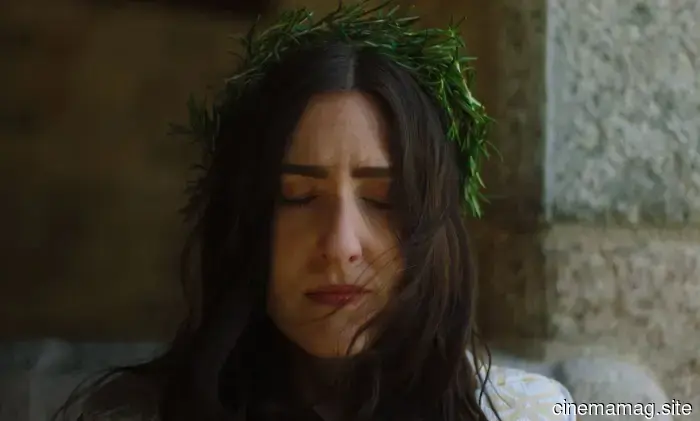
Although *Revelations of Divine Love* may not deliver a significant revelation, it is, at the very least, a visual and auditory delight. Its style and tone are entirely unique, perhaps appealing to fans of *The Love Witch* while maintaining enough medieval accuracy to attract those knowledgeable about the era or who have immersed themselves in *Kingdom Come: Deliverance II*. Golum's film is ambitious in its scope; while it may not fully unveil the individual at its center, the documentation of this woman's life is fulfilling in its own right. At 73 minutes, it doesn't linger unnecessarily, with lead actress Tessa Strain’s captivating presence guiding us in connecting to a past that mirrors many aspects of modern life.
*Revelations of Divine Love* premieres in theaters on Friday, March 27.
Other articles
.jpg) 4K Ultra HD Review – She Killed in Ecstasy (1971)
She Killed in Ecstasy, 1971. Directed by Jesús Franco. Featuring Soledad Miranda, Paul Muller, Fred Williams, Ewa Strömberg, Howard Vernon, Horst Tappert, and Jesús Franco. SYNOPSIS: Following her tarnished…
4K Ultra HD Review – She Killed in Ecstasy (1971)
She Killed in Ecstasy, 1971. Directed by Jesús Franco. Featuring Soledad Miranda, Paul Muller, Fred Williams, Ewa Strömberg, Howard Vernon, Horst Tappert, and Jesús Franco. SYNOPSIS: Following her tarnished…
 Special Poster for the 2026 Los Angeles Film Festival, Scheduled for April 9-12
One of the most expertly curated festivals in the United States is set to start next month. The third edition of the Los Angeles Festival of Movies, co-presented by Kino Film Collection and Mezzanine, will run from April 9 to 12 and will showcase notable films including Blue Heron, Maddie's Secret, Chronovisor, With Hasan in Gaza, and others. Co-founded by Micah Gottlieb and Sarah Winshall, LAFM is held on
Special Poster for the 2026 Los Angeles Film Festival, Scheduled for April 9-12
One of the most expertly curated festivals in the United States is set to start next month. The third edition of the Los Angeles Festival of Movies, co-presented by Kino Film Collection and Mezzanine, will run from April 9 to 12 and will showcase notable films including Blue Heron, Maddie's Secret, Chronovisor, With Hasan in Gaza, and others. Co-founded by Micah Gottlieb and Sarah Winshall, LAFM is held on
 Akiva Schaffer from The Naked Gun is set to direct a Cinderella spinoff that will center around the Ugly Stepsisters.
Disney's live-action Cinderella stands out as one of the studio's more successful attempts at drawing from its own archive for theatrical material, and now Anastasia and Drizella, the creators of…
Akiva Schaffer from The Naked Gun is set to direct a Cinderella spinoff that will center around the Ugly Stepsisters.
Disney's live-action Cinderella stands out as one of the studio's more successful attempts at drawing from its own archive for theatrical material, and now Anastasia and Drizella, the creators of…
Revelations of Divine Love Review: A Delightfully Enchanting Medieval Story with Contemporary Relevance
Medieval life occurred such a long time ago that we tend to see it as something foreign and are amazed at how individuals managed to live that way. This perspective is, of course, misguided: human nature has remained relatively stable over time, as have diseases, social unrest, and the necessary arrangements for celebrations. Caroline Golum’s Revelations of Divine