
Cannes Review: Dominga Sotomayor’s La Perra Abandons Simple Metaphors for Suggestive Mysteries
On the windswept island where Dominga Sotomayor’s La Perra takes place, there’s a location where gas bubbles up from the sea. A pipeline has burst near the shore, and it has released fumes for ages. This phenomenon is considered a local miracle: people come to light their lighters and observe the flames flickering on the water’s surface, which adds to the film’s atmosphere of strange mysteries. Sotomayor’s earlier films—each influenced by childhood memories—also dealt with the unpredictable forces of nature. Water serves as a significant theme in her 2012 debut Thursday till Sunday, which follows a tumultuous family road trip to Northern Chile's beaches, and in Swim to Me, which explores class tensions from a wealthy Santiago home; meanwhile, in Too Late to Die Young, a fire destroys a bohemian community in the hills around the capital as the country enters its post-Pinochet phase. La Perra, adapted from Pilar Quintana’s 2017 novel of the same title, marks a shift from Sotomayor's autobiographical style, but still delves into the connection between people and the landscape surrounding them.
If you are familiar with her works, you’ll recognize the pattern: Sotomayor often places her characters in tight spaces that trap them rather than offer them freedom, and her skillful use of familiar domestic settings is a signature of her style. Much of Thursday till Sunday unfolds in a car, and Too Late to Die Young takes place in the hillside retreat; Swim to Me rarely leaves the villa at its heart. In adapting Quintana's novel, Sotomayor and co-writer Inés Bortagaray change the setting from the lush jungle of the Colombian Pacific to an island off the southern coast of Chile. It is here that the childless 40-something Silvia (Manuela Oyarzún) was born and raised, and although the mainland is just a short ferry ride away, it seems unlikely she has ever ventured far. Portrayed by Oyarzún, who possesses the distinct beauty reminiscent of a Modigliani woman, she shares a deep connection with her homeland. Like many other islanders, Silvia makes a living selling seaweed, and in its initial scenes—meticulously depicting this business—La Perra evokes the films of Jean Epstein, another filmmaker who transformed maritime settings into significant characters themselves.
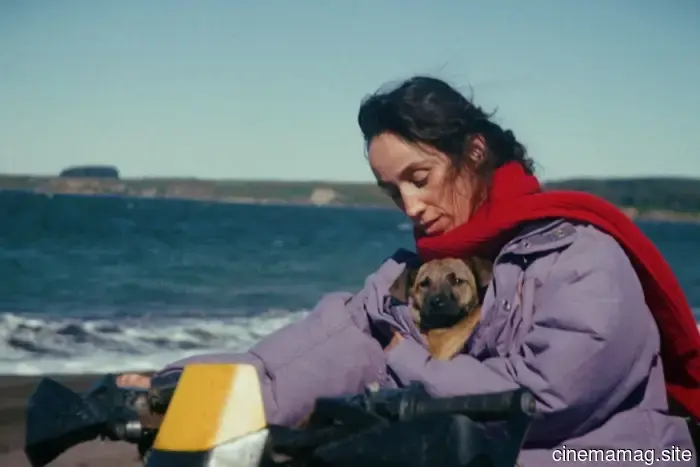
The tension between the fictional foreground and the real-world backdrop persists throughout the film, even as Silvia encounters the titular dog, a stray puppy she chooses to adopt and names after the 1980s Mexican pop star whose songs echo from her rickety television: Yuri. This moment triggers the narrative; the dog disrupts Silvia’s solitary life, and the film essentially chronicles the consequences of this pivotal event. However, La Perra is not driven by narrative in the conventional sense, and its disregard for dramatic norms enhances its impact. While adopting the dog indeed alters Silvia—sending her on a journey of self-discovery that compels her to confront childhood traumas—this transformation feels almost secondary to the film’s refusal to treat the animal as merely a plot device for her character development.
La Perra’s refreshing perspective lies in its approach to Yuri. Rather than reducing the dog to a tired trope of a “best friend” filling an emotional gap, Sotomayor challenges the notion of domestication altogether. The pup is unruly, resistant to commands, and likely to run away at any opportunity. Additionally, the film itself, shot by Simone D’Arcangelo—best known for his collaboration with Alessio Rigo de Righi and Matteo Zoppis—resists being tamed. Early on, Sotomayor shifts focus from Silvia to follow Yuri as she wanders the island, barking at horses and scavenging for bones. By splintering the perspective to prioritize the dog’s experience over the woman's, La Perra reflects a similar carefree spirit as its canine co-star.
Even as the film revisits past moments to introduce us to preteen Silvia (Rafaella Grimberg) and the tragedy that likely shaped her strong bond with the island, this flashback—Sotomayor’s first—defies expectations. Instead of clearly distinguishing between the two time periods—using specific color palettes or era-appropriate props—Sotomayor leaves the timeline ambiguous. Contemporary smartphones and cars exist alongside objects from earlier years, creating a confusing blend of when events occur. La Perra was filmed on Isla Santa Maria, but the setting appears suspended in time; at its most perplexing, the film suggests a reality unanchored in time and place.
While Sotomayor cultivates an unsettling atmosphere, not every transitional shot of rain-drenched cliffs and desolate beaches carries significant weight, and the resolution risks tying up the journey too neatly. Nevertheless, following Swim to Me, a Netflix project that required her to tame her instincts for
Other articles
 Top Australian Online Slots for Real Money: 5 Most Reliable Casinos in Australia - Leading PayID Slots Selection -
Hello Aussie punters! Are you fed up with looking for the top online pokies casinos in Australia? No need to stress; we’re here to help you find the ideal option. Our
Top Australian Online Slots for Real Money: 5 Most Reliable Casinos in Australia - Leading PayID Slots Selection -
Hello Aussie punters! Are you fed up with looking for the top online pokies casinos in Australia? No need to stress; we’re here to help you find the ideal option. Our
 Top Australian Online Casinos for Real Money Gaming in 2026 - Leading Pokies & Quick Withdrawal Casino Sites -
The top online casinos in the Australian market for 2026 prioritize speed, trust, and genuine value over extravagant promotions. Players are now seeking quick withdrawals,
Top Australian Online Casinos for Real Money Gaming in 2026 - Leading Pokies & Quick Withdrawal Casino Sites -
The top online casinos in the Australian market for 2026 prioritize speed, trust, and genuine value over extravagant promotions. Players are now seeking quick withdrawals,
 Cannes Review: All of a Sudden Represents Ryusuke Hamaguchi's Most Compassionate, Humanistic Work to Date.
“Are healthy individuals genuinely alive?” This question echoes as a tagline for Ryusuke Hamaguchi’s latest film early in All of a Sudden. Marie-Lou (Virginie Efira), the director of a private clinic for the elderly in Paris, is observing a performance centered around Franco Basaglia, the Italian psychiatrist who, in the late 1970s,
Cannes Review: All of a Sudden Represents Ryusuke Hamaguchi's Most Compassionate, Humanistic Work to Date.
“Are healthy individuals genuinely alive?” This question echoes as a tagline for Ryusuke Hamaguchi’s latest film early in All of a Sudden. Marie-Lou (Virginie Efira), the director of a private clinic for the elderly in Paris, is observing a performance centered around Franco Basaglia, the Italian psychiatrist who, in the late 1970s,
 Top Australian Online Pokies for Real Money: 5 Most Reliable Casinos in Australia - Best PayID Pokies Selection -
Hey Aussie gamblers, are you fed up with looking for the top online pokies casinos in Australia? No need to fret, we’re here to help you discover the ideal option. Our
Top Australian Online Pokies for Real Money: 5 Most Reliable Casinos in Australia - Best PayID Pokies Selection -
Hey Aussie gamblers, are you fed up with looking for the top online pokies casinos in Australia? No need to fret, we’re here to help you discover the ideal option. Our
 Sophie Thatcher and Charles Melton Star in the Initial Teaser for Nicolas Winding Refn’s Her Private Hell
It has been a complete ten years since The Neon Demon, during which Nicolas Winding Refn engaged in extensive streaming projects like Too Old to Die Young and Copenhagen Cowboy, which could be seen as a valuable career on their own. Now, he is back to making feature films. Fortunately, from the initial glimpse, not much appears to have altered. As Her Private Hell makes its debut at Cannes today, the first teaser featuring Sophie has been released.
Sophie Thatcher and Charles Melton Star in the Initial Teaser for Nicolas Winding Refn’s Her Private Hell
It has been a complete ten years since The Neon Demon, during which Nicolas Winding Refn engaged in extensive streaming projects like Too Old to Die Young and Copenhagen Cowboy, which could be seen as a valuable career on their own. Now, he is back to making feature films. Fortunately, from the initial glimpse, not much appears to have altered. As Her Private Hell makes its debut at Cannes today, the first teaser featuring Sophie has been released.
-5-Leading-Instant-Withdrawal-Casinos-Reviewed-MovieMaker.png) Fast Payout Online Casinos Australia (May 2026): A Review of 5 Top Casinos with Instant Withdrawals - MovieMaker
Looking for the top fast payout casinos in Australia? Your quest concludes here; our expert team has dedicated hours to testing and reviewing more than 50 Australian casinos.
Fast Payout Online Casinos Australia (May 2026): A Review of 5 Top Casinos with Instant Withdrawals - MovieMaker
Looking for the top fast payout casinos in Australia? Your quest concludes here; our expert team has dedicated hours to testing and reviewing more than 50 Australian casinos.
Cannes Review: Dominga Sotomayor’s La Perra Abandons Simple Metaphors for Suggestive Mysteries
On the blustery island where Dominga Sotomayor's La Perra takes place, there is a location where gas surfaces from the ocean. A pipeline has ruptured near the coast, and vapors have been escaping from it for ages. This phenomenon is seen as a local marvel: residents gather to ignite their lighters and observe the flames flicker and sway.