
Cannes Review: Cristian Mungiu’s Fjord Is a Majestic, Resounding Success
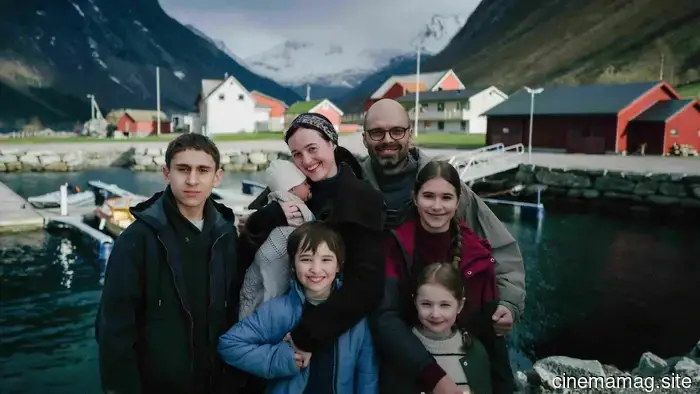
A gentle upright piano plays “Amazing Grace,” enveloping the opening scene of Fjord: a glacial mountain in powder-blue towering over the shimmering Norwegian fjord where Lisbet (Renate Reinsve) and Mihai Gheorghiu (Sebastian Stan) have relocated their family of seven. Lisbet, a Norwegian nurse, and Mihai, a Romanian aeronautical engineer, have just moved from Bucharest to this picturesque coastal village in Norway, where their devout evangelical Christian beliefs are more favorably regarded in their conservative homeland, which writer-director Cristian Mungiu has scrutinized in his previous films (Graduation, R.M.N.) for the shortcomings of its highly traditional society.
The Gheorghius don’t seem particularly sociable. They devote most of their free time to singing worship songs and reading the scriptures, insisting that their children do the same. Their two eldest teenagers, Elia (Vanessa Ceban) and Emmanuel (Jonathan Ciprian Breazu), who are strict adherents to rules, have no internet access, let alone YouTube. When Elia encounters an electric piano at school, she instinctively plays a hymn, just as her father had done while exploring the campus. They are gently reprimanded by the nearby Norwegians. “We don’t do evangelism at school,” Mats, their neighbor, smiles as he tells Elia. Their clothing reflects their conservative values: Lisbet wears long, unflattering grey skirts and Mennonite-style hair gathered up, while Mihai sports turtlenecks and blazers.
Their firm stance against homosexuality is appalling, and their casual approach to spanking their children is an outdated practice from the past. Both are relics in a contemporary global era that perceives such ideological strongholds as thought crimes—in Norway, they are considered actual crimes. This is evident when, one afternoon, after a teacher suspects that the children have been spanked, Child Protective Services arrive unannounced to take the children while they investigate. Yet, like anyone else, the Gheorghius are entitled to their freedoms and a fair legal defense against the stringent Norwegian authorities that have become so liberal that they've begun to harm the minorities within the country. (“They never had communism,” Mihai critiques.)
Fjord explores several pivotal questions. The foremost is whether the Gheorghius are physically abusing their children. However, when they acknowledge occasionally spanking them, and the children affirm the same, the question shifts: should parents be permitted to do this? If not, what should be the consequences for parents? Should their children be taken away for the entirety of their youth? Another critical question, which the film leaves unresolved for the audience, looms: when does spanking transition into beating or physical abuse?
Civil and criminal trials hover over Lisbet and Mihai as they prepare for their widely publicized civil trial, which CPS keeps delaying, hoping to have the criminal trial—which will likely result in the Gheorghius' conviction—occur first. In a clash between cultural beliefs and legal obligations, the Gheorghius ask Mia (Lisa Carlehed)—a liberal atheist neighbor whose rebellious daughter influences Elia and Emmanuel—to represent them. Mia agrees, viewing the state's position as excessively harsh and detrimental to the children for something as minor as spanking when the Gheorghius have vowed to cease this practice and were unaware they were committing a crime. Together, they adopt a religious-discrimination narrative portraying the Gheorghius as victims of bias.
In the background, avalanches fall in the western Norwegian port town, symbolizing the layers of icy, unfeeling behavior typical of the Norwegians depicted in the film (with the exception of Mia, who considers the matter with rationality beyond legal boundaries). The CPS representative who first informs Lisbet of the situation speaks so clinically that it feels as if she was pre-programmed, devoid of empathy or logical reasoning. Nonetheless, she acts on behalf of the state, endorsing principles that many would support, including: "You shouldn't hit your kids."
The original attorney who represents them adopts the same unemotional, robotic demeanor before abandoning them calmly, merely because they express upset. There’s irony in a rationalism that overlooks the essence of humanity. For example, a CPS representative asserts there’s no proof that children are better off with non-abusive biological parents than with foster parents if the children develop a good relationship with their new guardians—an assertion easily debunked.
Against the cold, oppressive, and heartless portrayal of the Norwegian CPS, aimed at minimizing risk, the Gheorghius’ strict and seemingly silly rules for their children appear as something they will simply outgrow rather than as life-altering issues. Mungiu highlights this lack of strictness by demonstrating how easily Elia and Emmanuel can transgress their parents’ rules when pressured by Noora (Henrikke Lund Olsen), a reality familiar to anyone raised in a religious environment.
While Norway's ideals may be

Other articles
 Cannes Review: Cristian Mungiu’s Fjord Is a Resounding, Lavish Success
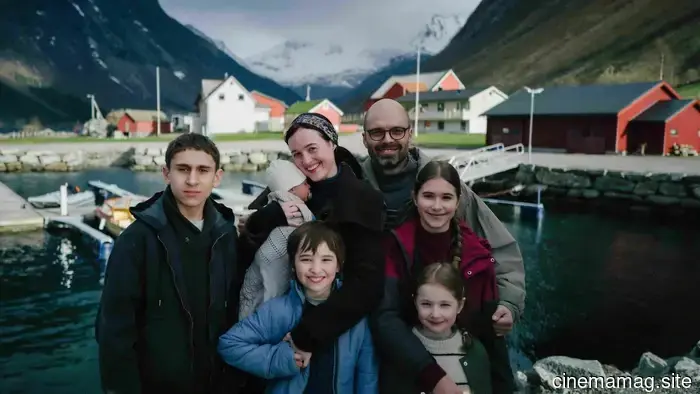
A gentle upright piano playing "Amazing Grace" envelops the initial scene of Fjord: a pale blue glacial mountain rising above the sparkling Norwegian fjord where Lisbet (Renate Reinsve) and Mihai Gheorghiu (Sebastian Stan) have established their seven-member family. Lisbet, a nurse from Norway, and Mihai, an aeronautical engineer from Romania, have recently relocated to the
Cannes Review: Cristian Mungiu’s Fjord Is a Resounding, Lavish Success
A gentle upright piano playing "Amazing Grace" envelops the initial scene of Fjord: a pale blue glacial mountain rising above the sparkling Norwegian fjord where Lisbet (Renate Reinsve) and Mihai Gheorghiu (Sebastian Stan) have established their seven-member family. Lisbet, a nurse from Norway, and Mihai, an aeronautical engineer from Romania, have recently relocated to the
.jpg) Film Review – Saccharine (2026)
Saccharine, 2026. Written and directed by Natalie Erika James. Featuring performances by Midori Francis, Danielle Macdonald, Madeleine Madden, Joseph Baldwin, Robert Taylor, Emily Milledge, Lisa Crittenden, and Lucy Goleb…
Film Review – Saccharine (2026)
Saccharine, 2026. Written and directed by Natalie Erika James. Featuring performances by Midori Francis, Danielle Macdonald, Madeleine Madden, Joseph Baldwin, Robert Taylor, Emily Milledge, Lisa Crittenden, and Lucy Goleb…
Cannes Review: Cristian Mungiu’s Fjord Is a Majestic, Resounding Success
A gentle upright piano playing "Amazing Grace" gently envelops the initial scene of Fjord: a glacial mountain with a powder-blue tint rising majestically over the shimmering Norwegian fjord where Lisbet (Renate Reinsve) and Mihai Gheorghiu (Sebastian Stan) have relocated with their seven-member family. Lisbet, a Norwegian nurse, and Mihai, a Romanian aeronautical engineer, have just settled in the