
Cannes Review: Cristian Mungiu’s Fjord Is a Resounding, Lavish Success
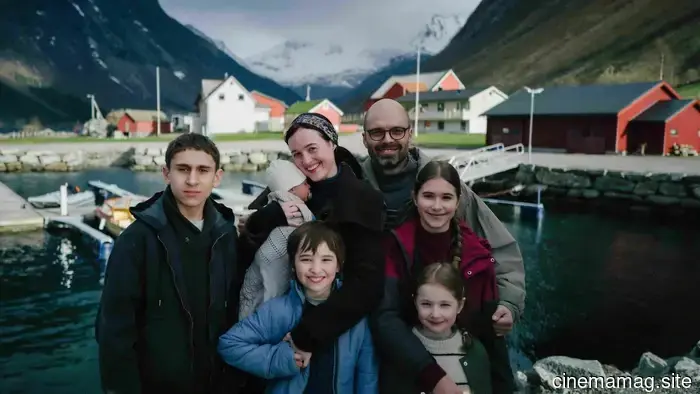
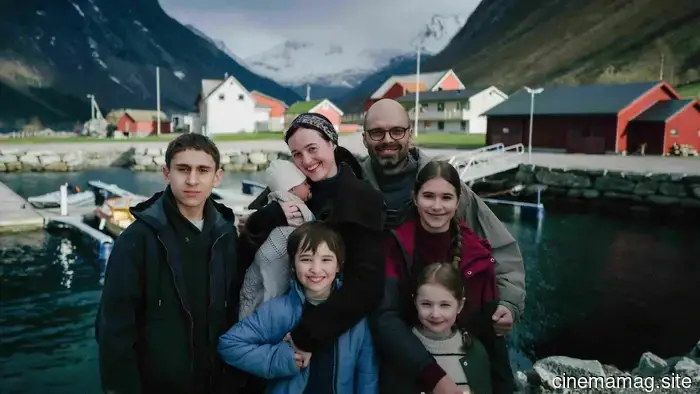
A gentle upright piano playing "Amazing Grace" warmly envelops the opening scene of Fjord: a towering glacial mountain in soft powder-blue shades looms over the shimmering Norwegian fjord, where Lisbet (Renate Reinsve) and Mihai Gheorghiu (Sebastian Stan) have relocated their family of seven. Lisbet, a Norwegian nurse, and Mihai, a Romanian aeronautical engineer, have recently moved to this picturesque coastal village in Norway from Bucharest, where their staunch evangelical Christian beliefs enjoy a more favorable standing in the conservative home country of writer-director Cristian Mungiu, whose previous films (Graduation, R.M.N.) have tackled the challenges of its ultra-traditional society.
The Gheorghius family does not seem particularly enjoyable to be around. They dedicate their free time to singing hymns and studying scripture, insisting their children participate as well. Their two eldest teenagers, the disciplined rule-followers Elia (Vanessa Ceban) and Emmanuel (Jonathan Ciprian Breazu), have no access to the internet or YouTube. Upon encountering an electric piano at school, Elia instinctively plays a hymn, reminiscent of her father's campus visits. They receive light reprimands from neighboring Norwegians. "We don’t do evangelism at school," Mats, their neighbor, tells Elia with a grin. Their clothing is conservative too: Lisbet wears long, unflattering grey skirts with her hair pinned back, while Mihai opts for turtlenecks and blazers.
Their staunch opposition to homosexuality is appalling, and their casual use of physical punishment on their children is a distasteful remnant of bygone generations. Both views stand out as antiquated in a contemporary global era that perceives such traditional ideological stances as thought crimes—in Norway, they are actual crimes. So severe is the situation that, one afternoon, following a teacher's suspicion of reported spanking, Child Protective Services arrives unannounced to investigate and take custody of the children. Nevertheless, like everyone, the Gheorghius family deserves their rights and a thorough defense against the uncompromising Norwegian state, which has shifted so far left that it risks harming the minorities within its borders. ("They never experienced communism," Mihai observes critically.)
Fjord delves into several pressing questions. The foremost is whether the Gheorghius are physically harming their children. When they candidly admit to occasionally spanking them, and the children corroborate this, the question shifts: should parents be permitted to use such methods? If not, what penalties should parents face? Should their children be removed from their care for their entire upbringing? Another unresolved question hangs in the air: when does spanking cross into beating or physical abuse?
Civil and criminal court proceedings loom ominously over Lisbet and Mihai as they prepare for their widely publicized civil trial, which CPS keeps delaying in anticipation of the criminal trial that is likely to result in a guilty verdict for the Gheorghius under Norwegian law. In this cultural versus legal clash, the Gheorghius enlist Mia (Lisa Carlehed)—a liberal atheist neighbor whose rebellious daughter, who engages in risky behavior, influences Elia and Emmanuel—to represent them. Mia agrees, viewing the state’s position as harsh and detrimental to the children over something as minor as spanking when the family has pledged not to repeat the act and were unaware they were breaking the law. Together, they adopt a religious-persecution angle, suggesting that the Gheorghius are facing discrimination.
Avalanches cascade in the backdrop of the western Norwegian port town, serving as a visual metaphor for the impenetrable layers of cold, inhuman behavior exhibited by most Norwegians in the film (with the exception of Mia, who approaches the situation with reason). The CPS representative who first explains the situation to Lisbet is so clinical that it feels as if she has been programmed, devoid of empathy or discernment. Yet she operates on behalf of the state, advocating principles with which nearly everyone would agree, such as the idea that “You shouldn't hit your kids.”
The attorney who initially takes their case adopts the same unyielding, robotic demeanor before departing, seemingly unfazed by their distress. There is an irony in this cold rationalism that overlooks the human experience. For instance, a CPS representative insists there is no evidence that children fare better with non-abusive biological parents than with compatible foster parents—a statement easily debunked without extensive research.
When contrasted with the frigid, oppressive portrayal of the Norwegian CPS acting in the name of mitigating risk, the Gheorghius family's rigid, albeit foolish, parenting rules seem more like issues they will eventually outgrow rather than practices that will devastate their lives. Mungiu highlights this lack of strictness by depicting how effortlessly Elia and Emmanuel break their parents' rules when influenced by their peer Noora (Henrikke Lund Olsen), a reality anyone raised in a religious environment knows well.
Even

Other articles
.jpg) Film Review – Saccharine (2026)
Saccharine, 2026. Written and directed by Natalie Erika James. Featuring performances by Midori Francis, Danielle Macdonald, Madeleine Madden, Joseph Baldwin, Robert Taylor, Emily Milledge, Lisa Crittenden, and Lucy Goleb…
Film Review – Saccharine (2026)
Saccharine, 2026. Written and directed by Natalie Erika James. Featuring performances by Midori Francis, Danielle Macdonald, Madeleine Madden, Joseph Baldwin, Robert Taylor, Emily Milledge, Lisa Crittenden, and Lucy Goleb…
 Cannes Review: Cristian Mungiu’s Fjord Is a Majestic, Resounding Success
A gentle upright piano playing "Amazing Grace" gently envelops the initial scene of Fjord: a glacial mountain with a powder-blue tint rising majestically over the shimmering Norwegian fjord where Lisbet (Renate Reinsve) and Mihai Gheorghiu (Sebastian Stan) have relocated with their seven-member family. Lisbet, a Norwegian nurse, and Mihai, a Romanian aeronautical engineer, have just settled in the
Cannes Review: Cristian Mungiu’s Fjord Is a Majestic, Resounding Success
A gentle upright piano playing "Amazing Grace" gently envelops the initial scene of Fjord: a glacial mountain with a powder-blue tint rising majestically over the shimmering Norwegian fjord where Lisbet (Renate Reinsve) and Mihai Gheorghiu (Sebastian Stan) have relocated with their seven-member family. Lisbet, a Norwegian nurse, and Mihai, a Romanian aeronautical engineer, have just settled in the
Cannes Review: Cristian Mungiu’s Fjord Is a Resounding, Lavish Success
A gentle upright piano playing "Amazing Grace" envelops the initial scene of Fjord: a pale blue glacial mountain rising above the sparkling Norwegian fjord where Lisbet (Renate Reinsve) and Mihai Gheorghiu (Sebastian Stan) have established their seven-member family. Lisbet, a nurse from Norway, and Mihai, an aeronautical engineer from Romania, have recently relocated to the