
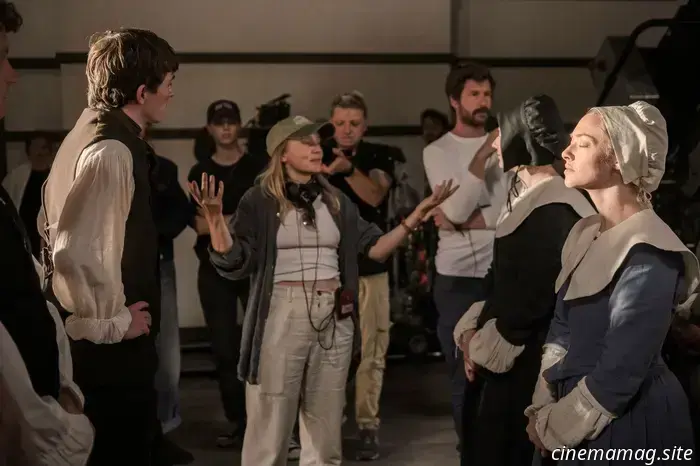
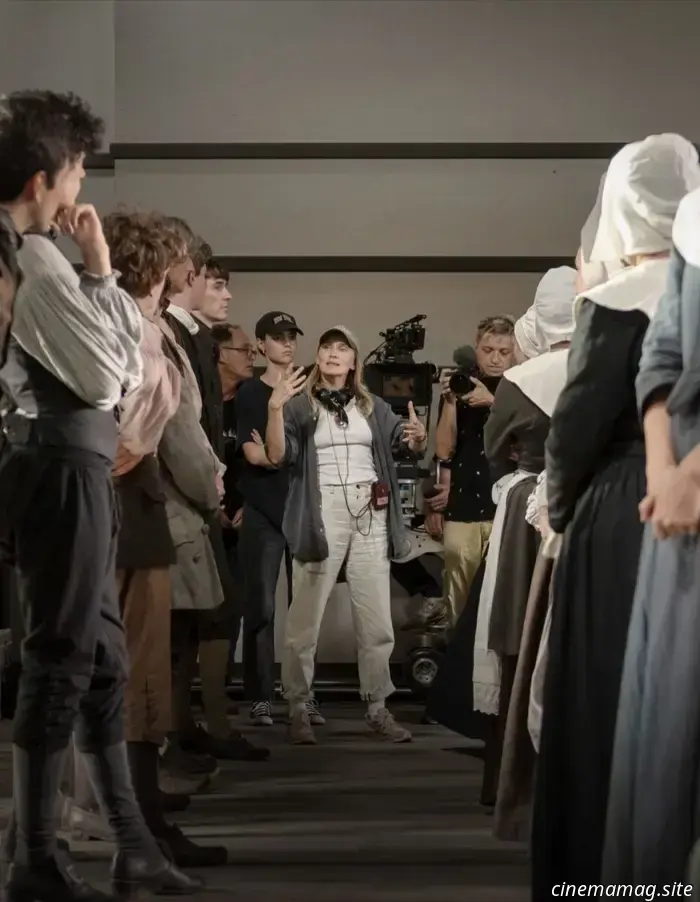
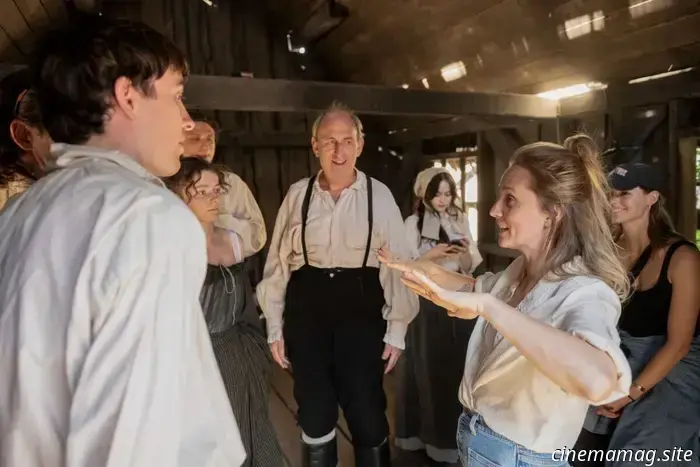
Mona Fastvold discusses The Testament of Ann Lee, maintaining her principles, and the influences of cinematic traditions.
With The Testament of Ann Lee, writer-director Mona Fastvold and her team continue the ambitious, Herzogian approach seen in last year's The Brutalist, a film she co-wrote and co-produced alongside her partner Brady Corbet. Whether filming in Hungary to save on set construction costs or choosing sheep over human extras, Fastvold, Corbet, and producer Andrew Morrison ensure that nearly every dollar spent is effectively represented on screen. This intention is evident early in the film through a striking boat sequence that transports the narrative from 18th-century Manchester to an America on the verge of independence. Their quest for a historically accurate ship took them all around, ultimately leading them to one docked in Sweden.
In the film, Amanda Seyfried portrays “Mother” Ann Lee, a devoted Quaker who establishes the Shaker movement, founded on principles of song, dance, artisanal furniture, and a vow of celibacy—this last point causes surprise and discomfort for Lee’s blacksmith husband, Abraham (Christopher Abbott). Mary Partington (Thomasin McKenzie), Ann Lee’s closest friend, narrates the story, guiding viewers through both historical and fantastical elements. Traditional Shaker hymns are transformed into elaborate musical numbers by composer Daniel Blumberg (The Brutalist, The World to Come) and choreographer Celia Rowlson-Hall (Ma).
In anticipation of the film's release on Christmas Day, I spoke with Fastvold about the tactile nature of matte-painted backdrops and handcrafted title cards, the film's dual voice-over, and the aspects aspiring filmmakers should never compromise on.
The Film Stage: In The World to Come, you emphasized a heavy use of voice-over. How have you further developed this approach in Ann Lee, integrating voice-over, music, and singing for an immersive audience experience?
Mona Fastvold: Sound is paramount. It envelops you completely; you can’t escape it. In The World to Come, the soundscape and voice-over are very introspective. It reflects Abigail’s internal experience. We sought the right microphones to create an ASMR-like atmosphere, where certain sounds, such as a hand being stroked or fire crackling, are emphasized as part of her memory. In The Testament of Ann Lee, while we still convey intimate and raw moments with Ann Lee, the voice-over interacts with the narrative more. There’s a balance between providing empathy for the character through camera work and performance, while maintaining a bit of distance since she represents a religious figure. I neither aim to idolize Ann Lee nor to judge her; I want that voice-over to reflect love. It's narrated by her best friend, as an unreliable narrator who suggests possibilities without certainty, framing the story as a fable. Yet it's delivered with a warmth that captures their friendship.
The sound design is the most intricate blend I've ever encountered. We spent weeks discovering the musicality within the mix. Collaborating closely with composer Daniel Blumberg, our mixer Steve Single, and effects mixer Andy [Neil], we created a captivating sonic environment. There's no clear distinction between the diegetic and musical realms; music and effects intertwine. I could have continued refining it endlessly, but we had a deadline with just four weeks available to produce a 70mm print for Venice.
In contrast to typical musicals that shift dramatically from dialogue to song, that approach felt inappropriate for this film. It wasn't meant to feature performative moments disconnected from the narrative. Instead, these segments should evoke heightened emotional experiences, rooted in faith and prayer, which are internalized.
Although they’re a smaller aspect, the title cards and illustrations featured throughout the film are striking. How did you develop those?
They were inspired by the Spirit drawings that appear as flashes in the film. If you can, visit the Hancock Shaker Village; their collection is remarkable. As various Shakers experienced the Spirit, they created art through drawing or painting. It's beautiful work. We hand-painted and filmed them, just like all the credits in the movie. I collaborated closely with my production designer, the scenic painter, and Sebastian Pardo, who also created the credits for The Brutalist. We developed these cards together, which played a significant role in the storytelling during production.
Sebastian is also a skilled documentary producer/distributor.
Yes, he’s quite the renaissance man—truly impressive.
At the AFI Fest screening, you advised filmmakers creating original works to maintain their vision without compromise. However, since art creation often necessitates some compromise, how do you determine which aspects you're unwilling to budge on while also ensuring the project gets completed?
Select the appropriate tools for telling your story. Whether it's celluloid, 35mm, large format, or even using an iPhone—whatever method best serves the narrative is non-negotiable. It's like hoping to create an oil painting, but deciding to only sketch it with a pencil. You must remain true to the medium you chose
Other articles
 Ankit Jhunjhunwala's Top 10 Movies of 2025
In line with The Film Stage’s collective ranking of the top 50 films of 2025, as part of our year-end recap, our contributors are revealing their individual top 10 lists. Every film mentioned below, except for one, debuted at a festival. Contrary to some assertions, 2025 has proven to be an outstanding year for cinema, featuring numerous significant works from both well-known and emerging directors.
Ankit Jhunjhunwala's Top 10 Movies of 2025
In line with The Film Stage’s collective ranking of the top 50 films of 2025, as part of our year-end recap, our contributors are revealing their individual top 10 lists. Every film mentioned below, except for one, debuted at a festival. Contrary to some assertions, 2025 has proven to be an outstanding year for cinema, featuring numerous significant works from both well-known and emerging directors.
.jpg) Film Review – The Choral (2025)
The Choral, 2025. Directed by Nicholas Hytner. Featuring Ralph Fiennes, Roger Allam, Amara Okereke, Simon Russell Beale, and Thomas Howes. SYNOPSIS: Male members of a choral society volunteer for service in World…
Film Review – The Choral (2025)
The Choral, 2025. Directed by Nicholas Hytner. Featuring Ralph Fiennes, Roger Allam, Amara Okereke, Simon Russell Beale, and Thomas Howes. SYNOPSIS: Male members of a choral society volunteer for service in World…
 Retro Games to Enjoy This Christmas Season
Andrew Newton showcases a collection of nostalgic retro games to savor this Christmas… With the gifts wrapped and the children settled in for the night, it’s time to carve out some time for ourselves…
Retro Games to Enjoy This Christmas Season
Andrew Newton showcases a collection of nostalgic retro games to savor this Christmas… With the gifts wrapped and the children settled in for the night, it’s time to carve out some time for ourselves…
.jpg) Film Review – No Other Option (2025)
No Other Choice, 2025. Directed by Park Chan-wook. Featuring Lee Byung-hun, Son Ye-jin, Park Hee-soon, Lee Sung-min, Yeom Hye-ran, Cha Seung-won, Kim Woo-seung, Choi So-yul, Kim Hyeong-mook, Woo Jeong-...
Film Review – No Other Option (2025)
No Other Choice, 2025. Directed by Park Chan-wook. Featuring Lee Byung-hun, Son Ye-jin, Park Hee-soon, Lee Sung-min, Yeom Hye-ran, Cha Seung-won, Kim Woo-seung, Choi So-yul, Kim Hyeong-mook, Woo Jeong-...
 Cillian Murphy’s Tommy Shelby returns in the trailer for Peaky Blinders: The Immortal Man.
Cillian Murphy’s Tommy Shelby returns in the trailer for Peaky Blinders: The Immortal Man.
Cillian Murphy’s Tommy Shelby returns in the trailer for Peaky Blinders: The Immortal Man.
 Comic Book Sneak Peek – Star Wars: Hyperspace Stories – The Bad Batch: Rogue Agents #1
Clone Force 99 is making a comeback next week as Dark Horse Comics releases Star Wars: Hyperspace Stories – The Bad Batch: Rogue Agents. You can take a look at the first issue with the official preview...
Comic Book Sneak Peek – Star Wars: Hyperspace Stories – The Bad Batch: Rogue Agents #1
Clone Force 99 is making a comeback next week as Dark Horse Comics releases Star Wars: Hyperspace Stories – The Bad Batch: Rogue Agents. You can take a look at the first issue with the official preview...
Mona Fastvold discusses The Testament of Ann Lee, maintaining her principles, and the influences of cinematic traditions.
With The Testament of Ann Lee, writer-director Mona Fastvold and her team maintain the ambitious Herzogian approach seen in last year's The Brutalist, which she co-wrote and co-produced alongside partner Brady Corbet. Whether filming in Hungary to reduce set construction costs or opting for sheep instead of human extras, Fastvold, Corbet, and producer Andrew Morrison ensure that almost