

The Prospects of Independent Filmmaking in a Platform-Oriented Era - MovieMaker Magazine
Independent filmmaking has always navigated a tension between creative freedom and restricted access to financial resources, screens, media coverage, distributors, and audiences. In today’s platform-driven landscape, this tension has evolved. While production has become more accessible than ever, visibility is increasingly influenced by platforms, metrics, and recommendation systems.
Digital tools have enabled filmmakers to shoot, edit, fund, market, and distribute their work outside conventional studio frameworks. However, the platforms that promise access frequently determine what content is highlighted, what is downplayed, and which narratives appear commercially viable. The future of independent filmmaking will belong to creators who can safeguard their voice while grasping the systems that influence discovery.
The Transformation of Indie Filmmaking in the Digital Era
Indie filmmaking has undergone significant transformation in the digital era. Tasks that once required costly film stock, specialized equipment, larger teams, and access to traditional post-production facilities can now be accomplished with more efficient tools, smaller crews, and adaptable workflows.
Affordable cameras, lightweight setups, accessible editing software, and cloud collaboration have empowered independent filmmakers to produce work with a level of refinement that was once challenging outside the studio structure. Techniques such as practical VFX, virtual production experimentation, and AI-assisted workflows can further cut costs, allowing small teams to pursue ambitious visuals and processes that previously demanded much larger financial resources.
However, the most profound change transcends technical advancements. Indie filmmakers now operate within a web of crowdfunding platforms, online film communities, social media audiences, digital festivals, niche streaming services, and direct-to-fan release strategies. Production has become more democratic, yet also more fragmented. While making a film remains a tough endeavor, ensuring it reaches an audience has become a discipline of its own.
How Platforms Are Redefining Independent Cinema
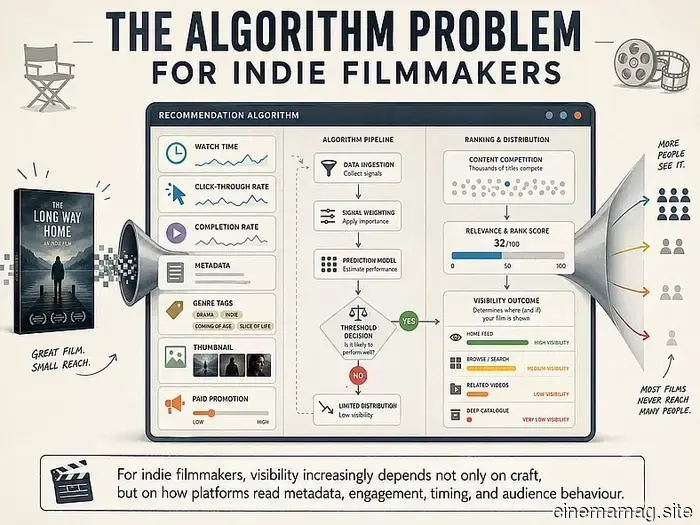
As production tools and funding methods have become more accessible, the locus of power within independent cinema has shifted towards platforms that control discovery, audience data, monetization, and attention. The traditional gatekeepers have not vanished; rather, their influence has been shared with recommendation algorithms, analytics dashboards, and engagement metrics.
In the realm of platform-driven entertainment, gatekeeping has less to do with a single distributor or festival jury granting approval and more with whether a film aligns with the categories, thumbnails, lengths, metadata, and viewing trends recognized by platforms. The pressure is subtle yet real, leading filmmakers to consider not just their narrative and audience but also the survival of their work in a crowded feed.
This creates both opportunities and challenges. While platforms can help niche films connect with viewers across different regions, they may also favor familiar tropes over innovative storytelling. They can provide independent cinema with new marketing avenues while simultaneously making filmmakers more reliant on systems beyond their control. The trajectory of independent cinema will depend on how effectively creators can leverage these platforms without allowing them to dilute the essence of their work.
Indie Film Distribution in an Era of Streaming
In a streaming-centric marketplace, indie films can reach audiences further than ever before, though this expansion often comes with new constraints. While platforms can enhance access, they can also limit control over data, pricing, release windows, and the long-term availability of films.
Consequently, distribution cannot be viewed merely as a final step following a film's completion; it has become integral to both creative and business strategies from the outset. The most successful independent releases often combine festivals, limited theatrical engagements, streaming opportunities, direct sales, community screenings, and targeted online campaigns instead of depending on a singular route.
For filmmakers attempting to navigate this evolving landscape, resources like the Sundance Creative Distribution Initiative are valuable, as they redefine distribution as an amalgamation of funding, marketing, audience development, and release strategies rather than a simple transfer to a platform or distributor.
What Platforms Offer — and What They Compromise
For many indie filmmakers, platforms provide an opportunity that once seemed near impossible: to reach audiences beyond geographical limitations, local press coverage, and theatrical availability. A small film can be discovered by viewers in various countries, engage in niche discussions, and gain support from audiences who might never have encountered it through traditional distribution methods.
However, this access comes with trade-offs. Platform agreements can restrict rights, diminish transparency, or complicate long-term revenue predictions. Access to viewership data might be limited or unavailable, hindering a filmmaker’s ability to understand their audience and negotiate future opportunities.
Additionally, visibility is a challenge. A film may technically be available, yet practically invisible if it is not promoted, categorized, recommended, or presented to the appropriate viewers. In a crowded market, distribution does not guarantee discovery.
The Rise of Self-Distribution Approaches
Self-distribution is increasingly appealing to filmmakers who desire greater control over rights, pricing, audience interactions, and release timing. Rather than waiting for a conventional distributor to resolve every issue, independent creators are progressively crafting release strategies centered around their communities and direct channels.
This path is not without its challenges; it demands operational diligence, including deliverables, marketing materials, payment systems, media outreach
Other articles
 The Top Movies of Each Decade, Based on Rotten Tomatoes Ratings
Below is a list of the top movies from each decade, as rated by Rotten Tomatoes.
The Top Movies of Each Decade, Based on Rotten Tomatoes Ratings
Below is a list of the top movies from each decade, as rated by Rotten Tomatoes.
 The B-Sides of Eddie Murphy featuring Nicholas Gray and Alvin Keith
Welcome to The B-Side! This is the place where we discuss movie stars! Instead of focusing on the films that brought them fame or maintained their status, we explore the lesser-known projects they undertook in between. Today, we shine the spotlight on one of the most successful entertainers in history: Eddie Murphy! The B-Sides we’ll cover are: Metro, Holy Man, Life, and I Spy. Our guests
The B-Sides of Eddie Murphy featuring Nicholas Gray and Alvin Keith
Welcome to The B-Side! This is the place where we discuss movie stars! Instead of focusing on the films that brought them fame or maintained their status, we explore the lesser-known projects they undertook in between. Today, we shine the spotlight on one of the most successful entertainers in history: Eddie Murphy! The B-Sides we’ll cover are: Metro, Holy Man, Life, and I Spy. Our guests
 The Top Movies from Each Decade, Based on Rotten Tomatoes Ratings
Here are the top movies from each decade, as ranked by Rotten Tomatoes.
The Top Movies from Each Decade, Based on Rotten Tomatoes Ratings
Here are the top movies from each decade, as ranked by Rotten Tomatoes.
 A new Planet of the Apes film will be directed by Matt Shakman, known for The Fantastic Four: First Steps.
The planet will continue to be governed by apes, as 20th Century Studios has appointed Matt Shakman, director of The Fantastic Four: First Steps, to lead a new Planet of the Apes film. Shakman is currently working on…
A new Planet of the Apes film will be directed by Matt Shakman, known for The Fantastic Four: First Steps.
The planet will continue to be governed by apes, as 20th Century Studios has appointed Matt Shakman, director of The Fantastic Four: First Steps, to lead a new Planet of the Apes film. Shakman is currently working on…
 Matthew Lillard is set to join the cast of the Superman sequel, Man of Tomorrow.
As James Gunn works on the production of Man of Tomorrow, the follow-up to last summer's successful Superman, the co-chairman of DC Studios has revealed a new member joining the expanding cast, Matthe…
Matthew Lillard is set to join the cast of the Superman sequel, Man of Tomorrow.
As James Gunn works on the production of Man of Tomorrow, the follow-up to last summer's successful Superman, the co-chairman of DC Studios has revealed a new member joining the expanding cast, Matthe…
 Comic Book Sneak Peek – Conan & Dragonero #1
Next week, two legends will come together as Titan Comics premieres its exciting crossover series, Conan & Dragonero. You can check out the opening chapter with the official preview of the…
Comic Book Sneak Peek – Conan & Dragonero #1
Next week, two legends will come together as Titan Comics premieres its exciting crossover series, Conan & Dragonero. You can check out the opening chapter with the official preview of the…
The Prospects of Independent Filmmaking in a Platform-Oriented Era - MovieMaker Magazine
Independent filmmaking has consistently existed in a state of tension between artistic freedom and restricted access to resources such as funding, venues, media coverage, distributors, and viewers.