
Leviticus Review: Successful Australian Horror Film Merges Paranoia and Affection
Being queer—especially in this rapidly regressive era—often entails a baseline level of fear for most of one's life. This is a lesson learned early on: not only must you determine who you can rely on for your safety, but also whether that trust might be broken later. Violence manifests in many ways, leading to a kind of paranoia that curls back in on itself. Adrian Chiarella’s *Leviticus* captures this feeling deeply. By merging elements of *It Follows* with the trauma associated with conversion therapy, he has created a tense and thematically resonant feature debut that offers more than just a straightforward metaphor—it stands alone as a genuinely creepy horror film.
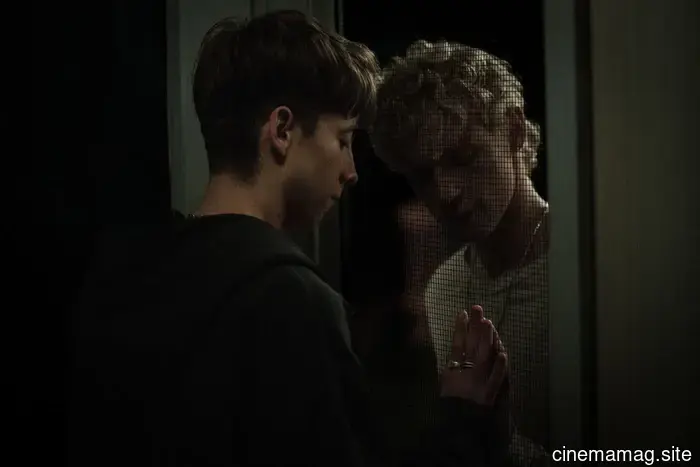
The scares commence quickly. *Leviticus* begins in a brightly lit swimming pool where a teenage girl is drawn to a shower that has inexplicably turned on. Just before her untimely demise, she seems to recognize someone in the room. Chiarella then introduces our main characters: Naim (Joe Bird, known from the Australian horror film *Talk To Me*) and Ryan (Stacey Clausen), who are initially seen playfully tossing rocks at each other before sharing a kiss. Both appear to have embraced their identities, yet living in a small Australian town brings an unspoken necessity to keep it hidden.
More urgent is the conservative Evangelical church they both attend; in fact, Naim’s recently widowed mother, Arlene (Mia Wasikowska), specifically relocated there to become part of the congregation. This scenario highlights the challenges faced by LGBTQ youth, requiring furtive glances in school and coded language around family. This strain ignites Naim's jealousy when he witnesses Ryan not only kissing the pastor’s son, Hunter (Jeremy Blewitt), but also gathering rocks with him.
Naim’s fateful decision to report this incident leads to Ryan and Hunter being taken before a “deliverance healer.” Whether it’s categorized as a ritual or a ceremony, the process resembles a horrifying exorcism: the healer flicks a lighter and the two boys start to convulse and foam at the mouth. Naim soon endures this ordeal in an incredibly heartbreaking and gut-wrenching moment that has him pleading with his mother, revealing the film's central concept: a malevolent entity now hunts the victim. This entity can assume the appearance of the one you love most, constantly watching and trailing you, drawing you into a deceptive sense of safety before violently striking.
Chiarella excels at crafting scares that go beyond the expected, but *Leviticus* (named after the biblical book often cited against homosexuality) receives a significant boost from the near-perfect integration of theme and concept. The aim of conversion therapy is not to "convert" someone to heterosexuality—this is unachievable—but rather to instill fear associated with their very identity. As Ryan states: “They want us to be scared of each other.”
This simple truth adds a powerful layer to the horror. It’s one thing to witness Ryan screaming as he bursts from a bathroom; it’s another to come to the realization that his ear—the very place Naim tenderly kissed during a rare moment of comfort on a bus—has been brutally mutilated. The terror stems not only from the monster but also from the notion that the things you love most about someone will be weaponized against you until either you destroy each other or turn on yourself.
This effectiveness would be diminished without Bird and Clausen’s natural chemistry. They excel even when apart, conveying profound emotions through simple glances or sighs. Surprisingly, Wasikowska sidesteps the cliched portrayal of a “homophobic mother.” Instead, she depicts Arlene as loving yet distant, with her inability to accept her son's sexuality driving her to make an unforgivable decision. This portrayal feels more authentic: parents often make choices driven by a misguided love that nonetheless inflict harm on their children in ways they cannot fully understand.
Ultimately, *Leviticus* unveils a sweet, hard-earned love story. It delves into how homophobia not only distorts personal perceptions but also affects how individuals are remembered after death, leading to a cycle of grief and violence (as illustrated by a retaliation from Hunter’s sister, Izzy). Chiarella shows some signs of a first-time filmmaker— the film does not balance the narrative equally between the boys, resulting in a climax that lacks the necessary intensity—and while it lasts a commendable 88 minutes, a bit more development of the narrative would not hurt.
However, Chiarella absolutely succeeds with the final scene, elevating *Leviticus* beyond its inspirations into a nearly hopeful realm. The fear is genuine, and it may never wane completely, but we have come too far to retreat into the closet. In a time when outsiders attempt to fracture the queer community through isolation, *Leviticus* posits that the most powerful form of resistance is merely staying

Leviticus Review: Successful Australian Horror Film Merges Paranoia and Affection
Identifying as queer—particularly in this swiftly regressive era—entails familiarizing oneself with a fundamental sense of fear for a significant portion of your life. It’s a lesson you grasp early: not just in finding out who you can rely on for your safety, but also in determining if that trust might be broken down the line. Violence manifests in numerous ways that it...