
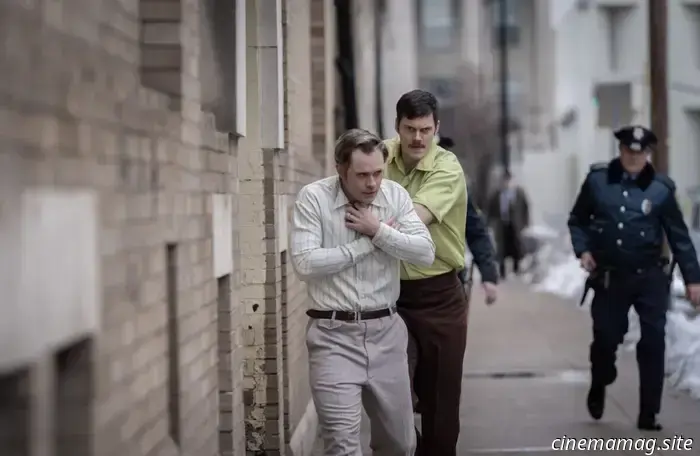
Bill Skarsgård, the star of Dead Man's Wire, claims that he is not portraying a monster this time.
You may not have expected the actor who brought Pennywise the Dancing Clown to life, as well as Barbarian’s Keith and Nosferatu’s Count Orlok, to take on a dramatized true crime film next. However, Bill Skarsgård was immersing himself in 1970s cinema and envisioning an actor-centric, “night-of” narrative when the chance to work on Dead Man’s Wire presented itself.
“It was one of those raw performances I was eager for at the time,” he shares. “So I jumped at the opportunity, even though it terrified me.”
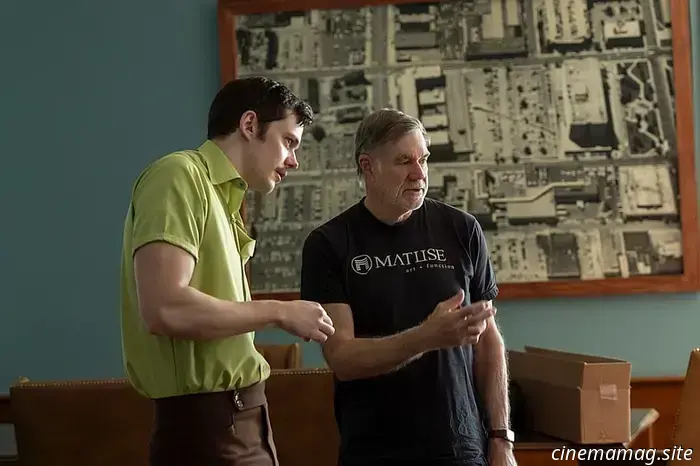
Collaborating with director Gus Van Sant felt like fate and was a clear choice for Skarsgård, who had admired his work for years. However, portraying the true story of Tony Kiritsis presented a different challenge for him — the actor doubted he could embody the character authentically.
In 1977, Kiritsis took over the offices of Meridian Mortgage Company in Indianapolis, holding president Richard Hall hostage for 63 hours. He wielded a sawed-off shotgun strapped to Hall’s neck, a contraption known as a dead man's wire.
Skarsgård worried he couldn’t portray Kiritsis truthfully due to their physical differences.
“The real man was in his mid-40s and a foot shorter than me, but Gus wanted me, and when I discussed it with him, the script was fantastic and the story was unbelievable,” recounts the 35-year-old Skarsgård. “I used the actual Tony as a guiding spirit for my performance, and I had a blast doing it.”
To transform physically, he utilized a wig and a mustache. Skarsgård portrayed Kiritsis as someone burdened with a lot of weight, rendering him tense, rigid, and slightly hunched — “from carrying all that weight.”
He also immersed himself in available footage and recordings of Kiritsis for inspiration, noting that Austin Kolodney’s script included links to the real-life situations. Additionally, he read Richard Hall’s memoir about the kidnapping and watched a documentary on the subject.
Skarsgård initially got so absorbed in the role that his performance felt too grounded in reality. Eventually, Van Sant encouraged him to adopt a more character-driven approach.
“He advised me to stop imitating the real person,” Skarsgård says. “So I released that and focused on his speech patterns and rage. The real guy was prone to extreme anger followed by apologies. He was infuriated but also had a humorous side. There was something charming about it. At one point, I had 17 pages of dialogue to rant through in one day.”
In reality, Kiritsis was frustrated over a $130,000 mortgage taken out with Meridian. He accused the company of sabotaging him once they learned the property's worth had increased. Consequently, he took Hall, portrayed by Dacre Montgomery (Stranger Things), hostage, forcing him to walk through the streets until they commandeered a police vehicle, making Hall drive to his apartment. Kiritsis then demanded an apology, $5 million, and assurance of immunity from prosecution for Hall's safe release.
The film tracks these tense events, meaning Skarsgård and Montgomery spent considerable time together on set in Louisville, Kentucky, which substitutes for Indianapolis.
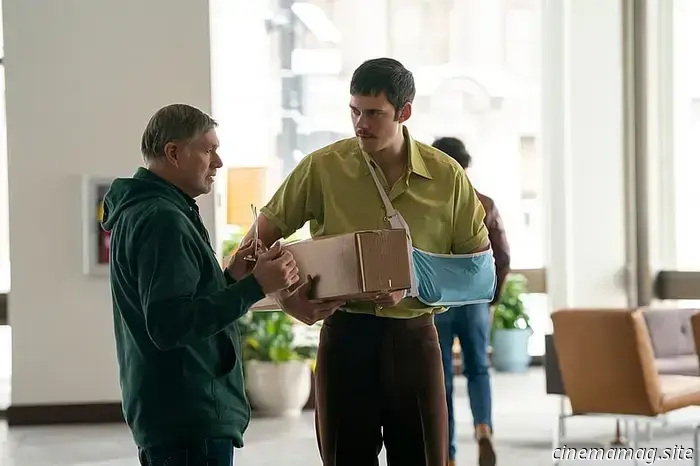
Skarsgård credits the idea to his co-star to map out the dead man's wire in a crucial opening scene, setting the film's tone. They filmed this on one of the first days of their 19-day shoot using two handheld cameras. Van Sant allowed them the freedom to improvise and let moments unfold organically.
“Dacre and I both bring a lot of energy and ideas as actors,” Skarsgård shares. “I sometimes describe Gus as having a Zen-like aura, both generally and in his filmmaking approach. He observes and allows Dacre and me to express our ideas until we’re out of steam, then he shapes it gently while letting the film find its own identity.”
Skarsgård mentions there were many spontaneous moments, including a telephone call scene involving him, Montgomery, and Al Pacino, who portrays Richard Hall’s father, M.L. Hall. This scene was not in the initial script and was suggested by Pacino.
Skarsgård praises Van Sant for allowing Dead Man’s Wire to evolve freely instead of forcing a vision upon it.
“Whenever those moments occurred, we built upon them, and many of the humorous or quirky lines were improvised,” he notes. “These came about as we were shooting in character and occurred spontaneously. It’s delightful when that happens, as it allows for surprises and unique gems that you could never really plan.”
He compares the concept of Dead Man’s Wire to one of his favorite ‘70s films, Mikey and Nicky, which features two long-time friends evading a mob boss.
“The entire film is improvised between Peter Falk and John Cassavetes
Other articles
 13 Films About the World's Oldest Profession That Present a More Sugary Perspective
The oldest profession in the world is often depicted in films, yet these movies frequently gloss over the more sinister aspects and present a softened version of reality.
13 Films About the World's Oldest Profession That Present a More Sugary Perspective
The oldest profession in the world is often depicted in films, yet these movies frequently gloss over the more sinister aspects and present a softened version of reality.
 John Fink’s Best 10 Films of 2025
In line with The Film Stage’s aggregated list of the top 50 films of 2025, which is part of our year-end review, our contributors are presenting their individual top 10 selections. In my yearly top ten, I strive to identify global trends in cinema, and while this is a somewhat ambitious endeavor, this year will be no exception. What does 2025 hold?
John Fink’s Best 10 Films of 2025
In line with The Film Stage’s aggregated list of the top 50 films of 2025, which is part of our year-end review, our contributors are presenting their individual top 10 selections. In my yearly top ten, I strive to identify global trends in cinema, and while this is a somewhat ambitious endeavor, this year will be no exception. What does 2025 hold?
 Comic Book Review – Star Trek: Voyager – Homecoming #4
IDW Publishing is set to release Star Trek: Voyager – Homecoming #4 on Wednesday, and we have the official preview of the issue for you to see below; take a look... Trapped in a difficult situation, Captain...
Comic Book Review – Star Trek: Voyager – Homecoming #4
IDW Publishing is set to release Star Trek: Voyager – Homecoming #4 on Wednesday, and we have the official preview of the issue for you to see below; take a look... Trapped in a difficult situation, Captain...
 The 12 Most Exciting Time Travel Films We've Ever Watched
Happy New Year! Here are the 12 most amazing time travel films we've ever watched.
The 12 Most Exciting Time Travel Films We've Ever Watched
Happy New Year! Here are the 12 most amazing time travel films we've ever watched.
 Prepare for one final adventure with the trailer for Netflix's The Making of Stranger Things 5.
Netflix has unveiled a trailer for One Last Adventure: The Making of Stranger Things 5, the forthcoming documentary that offers a behind-the-scenes look at the spectacular final season from the Duffer Brothers...
Prepare for one final adventure with the trailer for Netflix's The Making of Stranger Things 5.
Netflix has unveiled a trailer for One Last Adventure: The Making of Stranger Things 5, the forthcoming documentary that offers a behind-the-scenes look at the spectacular final season from the Duffer Brothers...
 Exclusive Poster for Marco Bellocchio’s Six-Hour Portobello, Launching on HBO Max in February.
A few months ago, Marco Bellocchio celebrated his 86th birthday. He is regarded as one of Italy's most distinguished directors and is one of the few filmmakers who has remained highly productive in his later years. After Kidnapped, he is now back with Portobello, a six-hour series comprised of six episodes. The first two parts premiered at the Venice Film Festival and will soon be available.
Exclusive Poster for Marco Bellocchio’s Six-Hour Portobello, Launching on HBO Max in February.
A few months ago, Marco Bellocchio celebrated his 86th birthday. He is regarded as one of Italy's most distinguished directors and is one of the few filmmakers who has remained highly productive in his later years. After Kidnapped, he is now back with Portobello, a six-hour series comprised of six episodes. The first two parts premiered at the Venice Film Festival and will soon be available.
Bill Skarsgård, the star of Dead Man's Wire, claims that he is not portraying a monster this time.
Bill Skarsgård, the star of Dead Man's Wire, has portrayed many of the most iconic monsters of our era. However, he asserts that Tony Kiritsis does not fall into that category.