
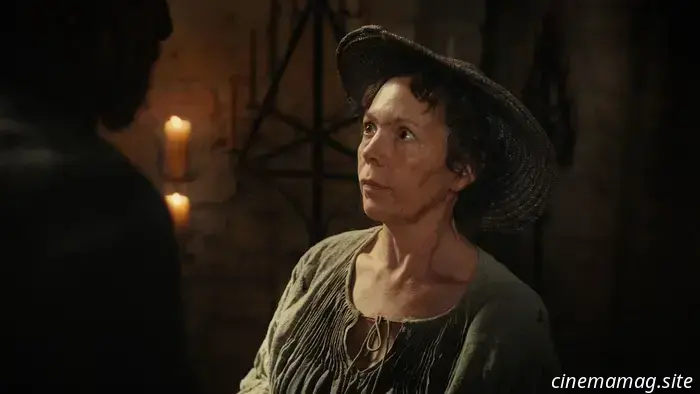
Sundance Review: Wicker Boldly Reflects on the Self-Destructive Dangers of Envy
The jealousy of discontented couples. The spitefulness of mean girls. The frustration of insecure husbands. It's a narrative as old as time that is uniquely interpreted by writer-directors Eleanor Wilson and Alex Huston Fischer in Wicker, an audacious and captivating film about an outcast woman, her husband made of wicker, and the village that falls apart due to their love.
This sophomore film is a lighthearted period piece set in a fictional time and place. Their screenplay, adapted from Ursula Wills-Jones’s short story The Wicker Husband, critiques patriarchal relationship dynamics and traditions. The world they create is akin to a funhouse mirror reflection of reality, allowing for a heightened setting that feels plausible despite its historical inaccuracies. The characters are not given proper names. Instead, in a jab at the outdated tradition of wives taking their husband’s last name, the men are identified by their professions and the women by their connections to those men. We witness the cruelty inherent in this society through the eyes of an outsider, a person who does not conform to its norms and becomes a target of ridicule because of it. Adding a bit of sweetness to their bitterness is the vulgar, boisterous way in which the village interacts, cleverly providing levity amidst their nastiness. Along with the sharp cultural satire, Wicker features a standout element: a wicker version of Alexander Skarsgård.
Though not explicitly stated, this adult fairy tale unfolds in an unspecified medieval English village where The Fisherwoman (Olivia Colman) faces ridicule for her disheveled appearance and lack of a husband. While her produce is fresh, her unibrow, fishy scent, and limp make her an easy target for mockery. She perceives love as "more of a burden than a prize." The only individual with whom she shares a respectful bond is The Basketweaver (Peter Dinklage), who also faces derision despite his skills.
After a wedding—during which, instead of exchanging rings, the husband fastens a matrimonial collar onto his bride—The Fisherwoman opens a woven "maid's egg," akin to catching the bouquet, which hints that she will be the next to marry; this is met with derision from the village. Leading the mean-spirited charge is the subtly passive-aggressive social leader of the village, The Tailor’s Wife, portrayed by the perfectly cast Elizabeth Debicki, whose commanding presence makes her the ideal storybook villain. The women of the town similarly uphold the status quo, belittling The Fisherwoman to lift themselves. By making her the target of ridicule, they maintain the fragile illusion that they are happy and life is good. However, when those at the bottom no longer conform to these rules, their house of cards collapses, leading to chaos.
Determined to ridicule their absurd customs, The Fisherwoman requests The Basketweaver to craft her a wicker husband. He agrees and produces a walking, talking, anatomically correct figure resembling Skarsgård.
The reveal of The Wicker Husband is breathtaking. The film excels in practical effects, thanks to Joe Dunckley and the New Zealand-based WETA Workshop, known for their impressive work on various tangible film projects over the last 40 years, including Mad Max: Fury Road and the Lord of the Rings trilogy. The woven elements operate with Swiss watch-like precision. Dunckley’s prosthetics allow Skarsgård to convey emotions while preserving his likeness and avoiding the grotesque. Enhancing this incredible effect is sound designer Andy Neil, who beautifully captures the sounds of the woven man. In his performance, Skarsgård channels his Scandinavian stoicism, embodying more of a Terminator than a Scarecrow, but what he represents as a sex symbol is crucial. Initially, the village is curious about this unusual creation, but the novelty shifts to the attention on his relationship with The Fisherwoman, which becomes the talk of the town.
While The Fisherwoman continues her work as a fisherwoman, her Wicker Husband stays at home, tending to the house and repairing their possessions. The village women grow envious of The Fisherwoman's capable partner and her role as the breadwinner. Additionally, the thunderous and passionate intimacy they share enhances their envy. Another catalyst for dissent is The Fisherwoman's new-found happiness. Those unhappy with their own lives cannot bear to see someone else flourish, especially if it contradicts their values. Her joy uncovers the underlying issues within the village’s relationships, which come to light and become a problem for the husbands, who awkwardly commiserate at the inn's bar. Wilson and Fischer take pleasure in portraying the animosity present in village households. The Tailor's Wife acutely feels this tension as a bright, talented woman stifled by her husband and overlooked by her father, The Doctor (Richard E. Grant). Recognizing the unrest in the village, she sets out to eradicate their inconvenient happiness.

Other articles
 Prime Video has released a new trailer for Guy Ritchie's Young Sherlock.
With only a month remaining until the premiere of Young Sherlock on Prime Video, a poster and trailer have been unveiled for Guy Ritchie's action mystery series. This series is inspired by Andrew Lane's Young Sherlock...
Prime Video has released a new trailer for Guy Ritchie's Young Sherlock.
With only a month remaining until the premiere of Young Sherlock on Prime Video, a poster and trailer have been unveiled for Guy Ritchie's action mystery series. This series is inspired by Andrew Lane's Young Sherlock...
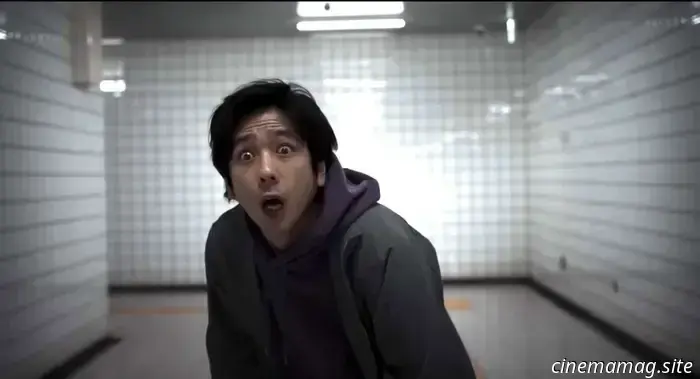 The Exit 8 trailer hints at Neon’s terrifying adaptation of a horror video game.
Neon has unveiled the official trailer for Exit 8, their adaptation of the well-known psychological horror game developed by Kotake Create. The film, directed by Your Name producer Kawamura Genki, centers on a…
Tooth Shop Fiasco Exclusive Trailer: Producer David Harari of Sasquatch Sunset Makes His Directorial Debut
David Harari, a producer for the Zellner Brothers' Sasquatch Sunset, has finalized his directorial debut with the indie comedy Tooth Shop Fiasco. This film is set to have its world premiere this Monday at the San Francisco Indie Festival. It features performances by Blaine Maye, Katie Folger, Ron Weisberg, and Rochelle Robinson, and is produced by George Rush, Michael Tully, and Chris Martin.
The Exit 8 trailer hints at Neon’s terrifying adaptation of a horror video game.
Neon has unveiled the official trailer for Exit 8, their adaptation of the well-known psychological horror game developed by Kotake Create. The film, directed by Your Name producer Kawamura Genki, centers on a…
Tooth Shop Fiasco Exclusive Trailer: Producer David Harari of Sasquatch Sunset Makes His Directorial Debut
David Harari, a producer for the Zellner Brothers' Sasquatch Sunset, has finalized his directorial debut with the indie comedy Tooth Shop Fiasco. This film is set to have its world premiere this Monday at the San Francisco Indie Festival. It features performances by Blaine Maye, Katie Folger, Ron Weisberg, and Rochelle Robinson, and is produced by George Rush, Michael Tully, and Chris Martin.
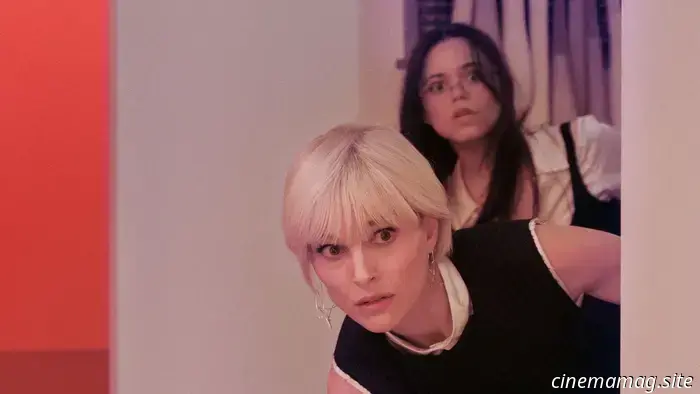 Sundance Review: The Gallerist Is Too Referenced to Effectively Satirize the Art Scene
Entering the art world is famously challenging—it’s already so absurd that the exaggeration required for effective satire falls flat. There’s no space left to explore. However, we require daring artists who tap into their inner Tobias Fünke and contemplate: “But it could succeed for us.” Therefore, Cathy Yan deserves significant recognition for
Sundance Review: The Gallerist Is Too Referenced to Effectively Satirize the Art Scene
Entering the art world is famously challenging—it’s already so absurd that the exaggeration required for effective satire falls flat. There’s no space left to explore. However, we require daring artists who tap into their inner Tobias Fünke and contemplate: “But it could succeed for us.” Therefore, Cathy Yan deserves significant recognition for
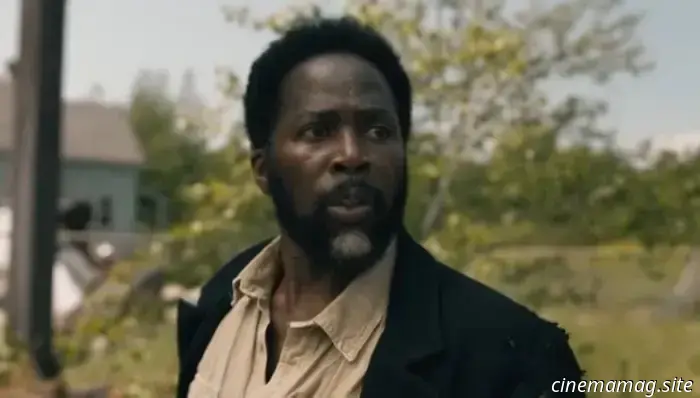 Season 4 announces an April release date along with an eerie new teaser trailer.
It has been more than a year since the dramatic finale of season three of MGM+'s popular horror series From, which ended with the eerie appearance of the unsettling, grinning 'Yellow Man', and now we f...
Season 4 announces an April release date along with an eerie new teaser trailer.
It has been more than a year since the dramatic finale of season three of MGM+'s popular horror series From, which ended with the eerie appearance of the unsettling, grinning 'Yellow Man', and now we f...
 Rotterdam Review: In Tokyo Taxi, Yoji Yamada Navigates Familiar Routes.
Forget about misunderstood hacks and generational talents. Nothing compares to a reliable studio player (with a solid 3- or 4-star batting average) who operates beneath the global radar for much of their career. By the time Neil Armstrong set foot on the moon, Yoji Yamada was nearing middle age and had already completed his 16th feature film, but it
Rotterdam Review: In Tokyo Taxi, Yoji Yamada Navigates Familiar Routes.
Forget about misunderstood hacks and generational talents. Nothing compares to a reliable studio player (with a solid 3- or 4-star batting average) who operates beneath the global radar for much of their career. By the time Neil Armstrong set foot on the moon, Yoji Yamada was nearing middle age and had already completed his 16th feature film, but it
Sundance Review: Wicker Boldly Reflects on the Self-Destructive Dangers of Envy
The envy of discontented couples. The spitefulness of cruel girls. The irritation of insecure partners. It's a story as old as time, vividly reimagined by writer-directors Eleanor Wilson and Alex Huston Fischer in Wicker, an audacious and enchanting film about an outcast woman, her husband made of wood, and the community that crumbles due to their love. This