
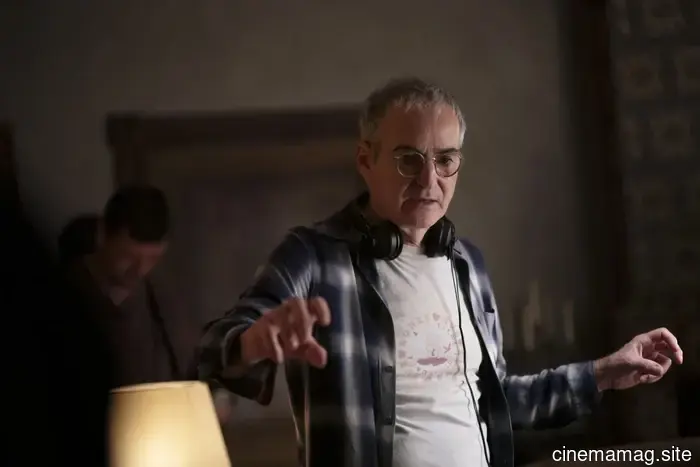
"Creating Films Should Be Enjoyable": Olivier Assayas Discusses The Wizard of the Kremlin
These days, there’s little space for films that are simply decent—especially from esteemed directors. Olivier Assayas' impressive filmography has long established his reputation as a great filmmaker, which sometimes makes it difficult to reconcile his genius with works that fall slightly short (especially when one of his notable pieces, the new Irma Vep, barely qualifies as a film). The Wizard of the Kremlin seems to me to be a fairly good film. I can also see why others might disagree: it’s a political thriller in name only, navigating a peculiar and somewhat fragile balance between satirical and serious, light-hearted and weighty, with Paul Dano’s leading performance requiring us to glean something from a character serving one of the world’s most ruthless leaders. I can relate to the criticisms made in our Venice review—one that still acknowledged Jude Law’s remarkable portrayal of Vladimir Putin, which avoids excessive makeup and theatrical voice modulation in favor of a well-timed pout and the tough-guy nuance of a British accent—while I also fondly consider Yorick Le Saux’s cold representation of Russian visuals.
As it stands, that review doesn’t capture what North American audiences will experience. The Wizard of the Kremlin is arriving here 20 minutes shorter than its original version, with an additional 10 minutes cut following a successful international release. The latter is the version preferred by Assayas, who candidly expressed his displeasure about the contractual obligations that led to unnecessary edits when we spoke a couple of months ago. However, having seen both theatrical versions, I can’t pinpoint how the film has materially or spiritually changed.
Assayas himself is unable to specify those changes in our recent conversation, timed with Wizard’s U.S. release this Friday. Our numerous discussions over more than 15 years have made our exchanges feel seamless. As our Zoom call began, I noticed his poster for Philippe Garrel’s The Inner Scar and an overflowing bookshelf.
The Film Stage: Is that your home office I see?
Olivier Assayas: Yes, it is. That’s where I keep my movie library, which I’ve been wanting to downsize. There are just too many books. It’s about to burst.
I admire and envy it. We spoke a couple of months ago and touched on Wizard, which I had just seen, and I’ve since rewatched the new 135-minute cut being released in the U.S. You were quite candid about your dissatisfaction with the removal of 10 minutes for this release. Watching it again after a couple of months, I honestly can’t say I noticed what was gone. I’m curious about what you think has been lost.
I believe the version being released works well. I’m not unhappy with it, to be honest. In terms of pacing, I thought the longer version had a slightly more satisfying flow, but I don’t think there’s anything significant worth discussing. I mainly made small tweaks here and there, which aren’t that consequential. I learned how to do this during the making of Les Destinées sentimentales. When I created Les Destinées sentimentales, which was three hours and 15 minutes long, I knew I could never sell that to my producer, so I had to cut 15 minutes from an otherwise satisfactory cut. I utilized every tool at my disposal, and I’ve learned to do that, so I understand how to pare down a film without it being painful.
To be completely honest: I would have preferred if the regular version, the longer version, had opened in the States because, sincerely, it doesn’t make a genuine difference. I can’t imagine that an audience willing to sit down for a two-and-a-half-hour film about modern Russian politics would be dissuaded by a slightly longer version. I don’t see that as an issue.
Upon rewatching, I focused more on the opening scene, which effectively establishes what the film will be.
It begins in a somewhat conventional manner, even though I’m very pleased with the scenes and shots. Still, it’s not exactly the film you’re going to experience. The film you’re about to watch is a bit more thrilling, hopefully—it has greater energy and captures something related to youthful vigor, which doesn’t come across in the early scenes.
In that scene, he discusses the one-way receiver phone, joking that it’s gray like so many things in Russia. The film itself feels quite authentic to the drab, oppressive Russian aesthetics yet remains visually engaging—not stiff, plastic, or bleak. I’d like to hear about how you organized and captured that in a way that feels genuine but still visually appealing.
I believe you need to stay connected to life. Even when depicting a lifeless world—and Soviet Russia was indeed that—people have hopes, feelings, and emotions, and it’s ultimately about how you represent these aspects. Cinema inherently requires some energy, and it’s vital to maintain a connection to that energy. Even when portraying a repressive
Other articles
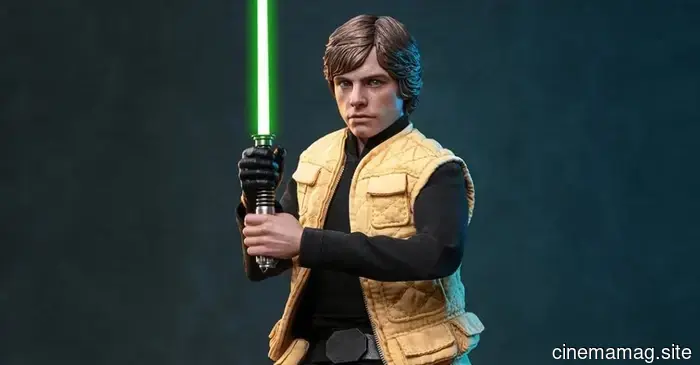 Luke Skywalker from Shadows of the Empire is now a part of Hot Toys' sixth scale action figure collection from Star Wars.
Hot Toys is exploring the Star Wars Legends collection for its latest sixth scale action figure – Luke Skywalker, as portrayed in the 1996 multimedia series Star Wars: Shadows of the Empire.
Luke Skywalker from Shadows of the Empire is now a part of Hot Toys' sixth scale action figure collection from Star Wars.
Hot Toys is exploring the Star Wars Legends collection for its latest sixth scale action figure – Luke Skywalker, as portrayed in the 1996 multimedia series Star Wars: Shadows of the Empire.
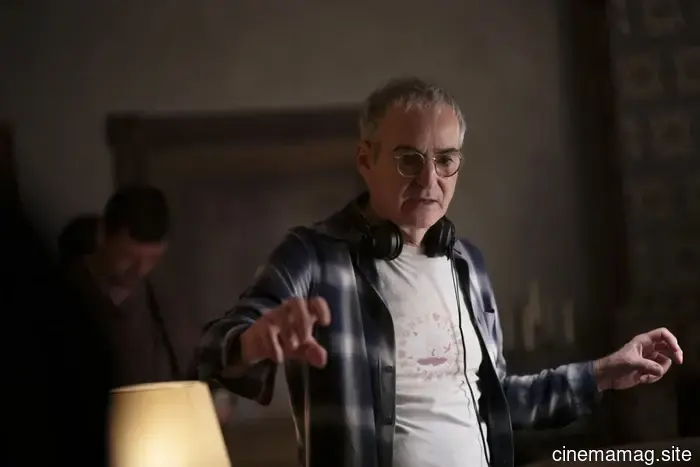 "Creating Films Should Be Enjoyable": Olivier Assayas Discusses The Wizard of the Kremlin
Nowadays, there's little space for films that are just fairly good, particularly when they come from esteemed directors. Olivier Assayas’ body of work has long established his reputation as a great director, making it challenging to reconcile his brilliance with the films that fall slightly short of that mark (especially when one of his celebrated films...
"Creating Films Should Be Enjoyable": Olivier Assayas Discusses The Wizard of the Kremlin
Nowadays, there's little space for films that are just fairly good, particularly when they come from esteemed directors. Olivier Assayas’ body of work has long established his reputation as a great director, making it challenging to reconcile his brilliance with the films that fall slightly short of that mark (especially when one of his celebrated films...
"Creating Films Should Be Enjoyable": Olivier Assayas Discusses The Wizard of the Kremlin
There’s limited space these days for films that are simply decent, particularly when they come from renowned directors. Olivier Assayas has long established his status as a great director, which makes it challenging to reconcile his brilliance with the movies that fall slightly short of that standard (and it doesn’t aid matters when one of his revered works...