
“Filmmakers Have No Reason to Retire”: Alex Cox Discusses His Comeback with Dead Souls
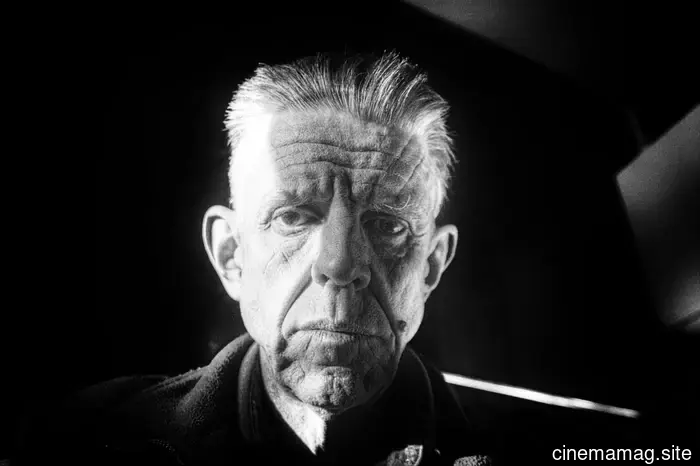
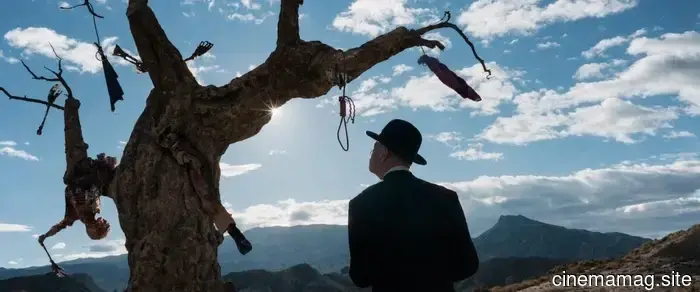
Alex Cox has reportedly completed his final film: a Western adaptation of Nikolai Gogol’s classic novel, Dead Souls. The story follows a wanderer in Tsarist Russia who journeys from town to town gathering the names of serfs who have died since the last census, making them considered taxable property—hence “dead souls.” Cox shifts the 19th-century Russian backdrop to the American Southwest around the same era and takes on the role of the protagonist himself.
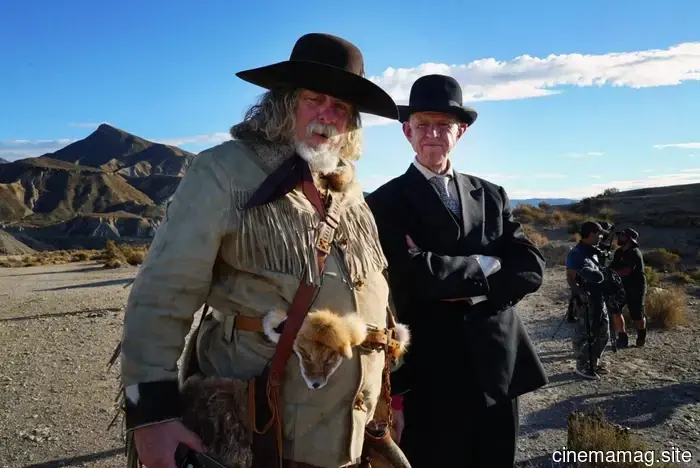
The film was financed through a Kickstarter campaign (I contributed in 2024) and experienced an unusual production process. Parts were filmed in the Almería desert in Spain at sites originally created for Sergio Leone’s For a Few Dollars More (1965), with the rest shot in Arizona. Filming concluded in November 2024, and Cox dedicated several months to editing the film, collaborating with his visual effects team to finalize the project while providing updates to his backers (one update hinted at a puppet flashback scene). The film has already been showcased at several festivals and will debut theatrically in the U.S. on July 2 in Seattle.
Having read Dead Souls, it’s understandable that it would resonate with Cox. The writing has a self-referential quality; the narrator often addresses the reader directly about the novel, reminiscent of some of Cox’s well-known postmodern elements: the generic food packaging in Repo Man (1984), the deliberate anachronisms in Walker (1987), and Malcolm McLaren’s finger guns along with Sid Vicious’ fantasy of shooting the audience in Sid and Nancy (1986). Reinterpreting a classic of Russian literature as a Spaghetti Western is a delightfully eccentric and creative choice for Cox, who is not the first punk inspired by this particular novel—it was the basis for a Joy Division song of the same name.
Cox is an avid fan of Spaghetti Westerns—having attended Oxford University, Bristol University, and UCLA, he reportedly wrote his thesis on the genre. His film Straight to Hell (1987) pays tribute to the gunslinging films of the 1960s. Dead Souls specifically contains numerous references to Sergio Leone. In addition to being filmed in locations originally designed for For a Few Dollars More (his all-time favorite Western), it features a title sequence styled after Leone's title designer, Iginio Lardani.
Cox finds himself as a middle-child in film history, born too late to be a "movie brat" yet too early for the ’90s indie rise. His films are marked by a distinct vision and a unique set of fixations: contemplations on politics, explorations of punk music’s allure, casting of older actors (such as Harry Dean Stanton, Dennis Hopper, and Derek Jacobi), subverting genre conventions, and a dark, satirical humor.
In our conversation, he reflected on his extraordinary, singular career and addressed queries about the financing, distribution, and physical production of Dead Souls.
The Film Stage: What prompted you to adapt Dead Souls as a Western specifically? Why not as a sci-fi or crime film?
Alex Cox: The book is naturally suited to a Western. Chichikov travels great distances in a wagon across open plains and arrives in small towns filled with suspicious and naive eccentrics. The conclusion of the first and only complete volume features the enigmatic hero racing through the night in his coach, uncertain of his destination but entirely exhilarated. To me, this embodies a Western.
Will it be an “acid Western” like Walker?
What constitutes an acid Western? I think of films like Zachariah or Greaser’s Palace, where the plot isn’t a main focus and the filmmaker attempts to recreate an LSD experience. Conversely, Walker has a very intricate plot, grounded largely in real events and figures. Set in Nicaragua and Mexico in the 1850s, it isn’t quite a Western; it’s more of a biopic. This genre can be quite effective: a recent example is Konchalovsky’s remarkable biography of Michelangelo, Sin. Dead Souls is more straightforwardly a Western, though not particularly acidic.
How did you approach the historical research for the film?
I enjoyed researching Johnny Behan's career from Tombstone to Yuma Jail, then to the Chinese Exclusion office in Texas. He is usually depicted as an antagonist who butted heads with Wyatt Earp, but he was a far more complex and successful character. This film marks the third occasion Jesse Lee Pacheco has portrayed Behan!
How do you adjust the Russian serfdom institution to a more modern American context?
The Tsar emancipated around 23 million serfs in 1861. Abraham Lincoln issued his Emancipation Proclamation in 1863, but slavery persisted until the end of the Civil War: even slaves remained in northern border states until then. Additionally, unpaid labor continued to be enforced through the prison system; in a sense, slavery never truly vanished
Other articles
 Comic Book Sneak Peek – Red Sonja: She-Devil with a Sword #3
Red Sonja: She-Devil with a Sword #3 will be released this Wednesday, and you can check out a sneak preview in the official preview below… This exciting new series continues the Dynamite launch by writer Rory…
Comic Book Sneak Peek – Red Sonja: She-Devil with a Sword #3
Red Sonja: She-Devil with a Sword #3 will be released this Wednesday, and you can check out a sneak preview in the official preview below… This exciting new series continues the Dynamite launch by writer Rory…
 A Filmic Oddity: Serenity
Matthew Shepherd on the 2019 movie Serenity... There exists a distinct type of Hollywood film that disregards all reason. It's not a film that was fated to flop from the start — a low-budget production featuring unknown actors...
A Filmic Oddity: Serenity
Matthew Shepherd on the 2019 movie Serenity... There exists a distinct type of Hollywood film that disregards all reason. It's not a film that was fated to flop from the start — a low-budget production featuring unknown actors...
 “Filmmakers Have No Reason to Retire”: Alex Cox Discusses His Comeback with Dead Souls
Alex Cox has (allegedly) finished his last film: a Western version of Nikolai Gogol’s renowned novel Dead Souls. The story centers around a wanderer in Tsarist Russia who goes from town to town gathering the names of serfs who have passed away since the most recent census, thereby deeming them taxable property—referred to as “dead souls.” Cox exchanges
“Filmmakers Have No Reason to Retire”: Alex Cox Discusses His Comeback with Dead Souls
Alex Cox has (allegedly) finished his last film: a Western version of Nikolai Gogol’s renowned novel Dead Souls. The story centers around a wanderer in Tsarist Russia who goes from town to town gathering the names of serfs who have passed away since the most recent census, thereby deeming them taxable property—referred to as “dead souls.” Cox exchanges
 A Cinematic Oddity: Serenity
Matthew Shepherd on Serenity (2019)… There exists a particular type of Hollywood film that contradicts all reasoning. It's not a film that was fated to fail from the start — it's a low-budget production featuring unknown actors...
A Cinematic Oddity: Serenity
Matthew Shepherd on Serenity (2019)… There exists a particular type of Hollywood film that contradicts all reasoning. It's not a film that was fated to fail from the start — it's a low-budget production featuring unknown actors...
“Filmmakers Have No Reason to Retire”: Alex Cox Discusses His Comeback with Dead Souls
Alex Cox has allegedly completed his last film: a Western version of Nikolai Gogol’s renowned novel Dead Souls. The story revolves around a wanderer in Tsarist Russia who journeys from one town to another gathering the names of serfs who have passed away since the most recent census, and are therefore regarded as taxable assets—hence the term "dead souls." Cox replaces