
Locarno Review: Nowhere to Lay My Eyes Presents a Revitalized Hong Sangsoo
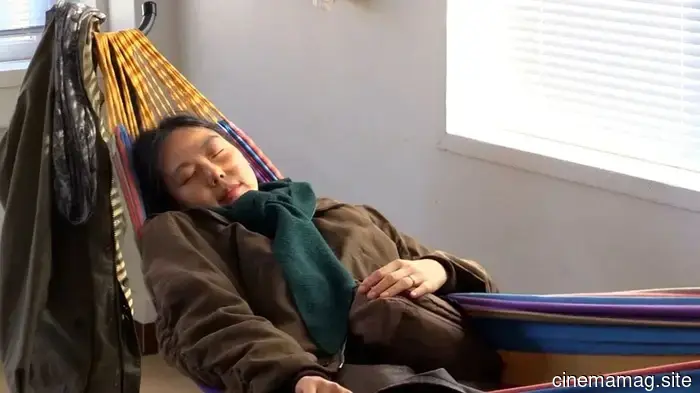
Hong Sangsoo’s Nowhere to Lay My Eyes is regarded by his fans as “a good Hong.” With 35 films already in his renowned oeuvre, that compliment can sometimes sound like faint praise, but Nowhere to Lay My Eyes appears to transcend the usual expectations. It offers humor and clarity, qualities that have been somewhat inconsistent in his recent works, and showcases a now-rare leading performance from Kim Min-hee, an actress whose involvement has always infused his films with vibrancy, steering them away from gloominess and self-pity—though those moodier Hongs have their merits as well.
For instance, in the opening scene, Kim’s character, Sang-hee, and her brother (Shin Seok-ho) arrive at the house of her mother (Choi Myung-gil) and stepfather (Kwon Hae-hyo) on Jeju Island, only for the stepfather—who is, notably, a director—to trip and fall as soon as he appears. We learn that Sang-hee was brought up by her grandparents on the mainland, and this marks her first encounter with her mother in a decade, as well as her initial meeting with her stepfather. It certainly sets the tone for what follows.
All four actors have collaborated regularly, but Kwon’s role, in particular, signals the type of Hong film this is. Since appearing alongside Isabelle Huppert in 2012’s In Another Country, Kwon has been consistently cast in similar roles. Typically, his characters are somewhat successful creatives, often serving as stand-ins for the director himself. Therefore, seeing Hong quickly diminish Kwon’s character’s stature early on provides a clear indication of the film's tone.
The main character is Kim’s Sang-hee—a woman in her forties who works for a company that imports “foreign snacks” (humorously!) and also, as she awkwardly conveys to her befuddled mother, creates experimental films that bear aesthetic resemblance to the short at the conclusion of Hong’s The Novelist’s Film. Sang-hee enjoys capturing everyday moments with a handheld digital camera, modestly sharing them on YouTube shortly afterward. In contrast, Kwon’s character has just completed a decade-long project and is now, for better or worse, embarking on a film about a grass tomb. It’s easy to guess which of their artistic approaches the director finds more favorable.
One insightful comparison I’ve seen for Hong’s work likens him to a painter who spends years exploring the same landscape repeatedly: sometimes the results are mere sketches, but occasionally—like in Nowhere, which still runs just 72 minutes—they coalesce into something more profound. About halfway through the film, Sang-hee encounters her stepsister, another artist who reveals her preference for a slow, repetitive working style. Sang-hee, via narration, admits to feeling a bit creeped out by her, alongside a tinge of jealousy regarding their mother’s closeness, yet the film still conveys warmth and artistic camaraderie between them.
Additionally, this qualifies as a “good Hong” simply because it presents itself in a sharp, bright, and polished manner, filled with those lovely, winding street shots that he favors. There’s also a somewhat rare yet refreshing use of narration (voiced by Kim), alongside one of Hong’s recent, fuzzy guitar soundtracks. This one has a somewhat grungy vibe, leading me to wonder if the director had recently come across Slint. There are, of course, several dinner scenes, including one where Sang-hee overindulges and makes an unflattering remark about documentary filmmakers, gravely wounding her stepfather’s pride—a classic Kwon moment.
More intriguingly, this sequence also includes a jarring reference to Gaza and contains a line where Hong essentially labels himself a scammer—which, I’m pleased to note, reflects a more assertive attitude than we’ve come to anticipate from the 65-year-old. The film concludes by presenting one of Sang-hee’s works: a poignant shot of a dandelion growing amid weeds, which she narrates like an out-loud journal entry. She discusses cinema (and possibly life) as a process of “regarding.” This description aptly fits several of the director’s recent films, but this one feels somehow more dynamic.
Nowhere to Lay My Eyes debuted at the 2026 Locarno Film Festival and will be released by Cinema Guild.
Locarno Review: Nowhere to Lay My Eyes Presents a Revitalized Hong Sangsoo
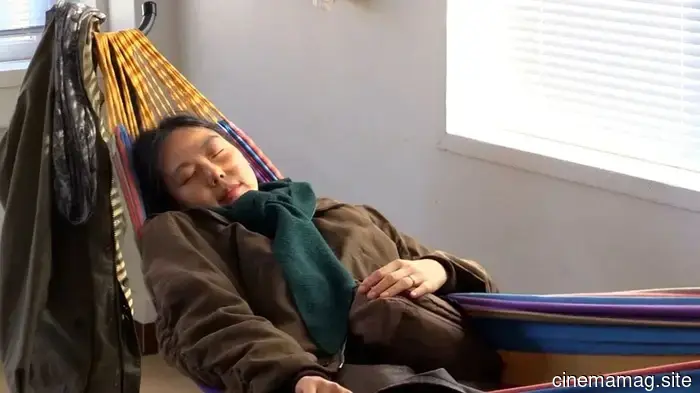
Hong Sangsoo's Nowhere to Lay My Eyes is, as his admirers often put it, "a classic Hong." With 35 films in his notably prolific career, that “classic” can sometimes sound like a mild compliment, but Nowhere to Lay My Eyes seems to transcend being merely a departure from the usual. It is humorous and sharply executed, neither of