
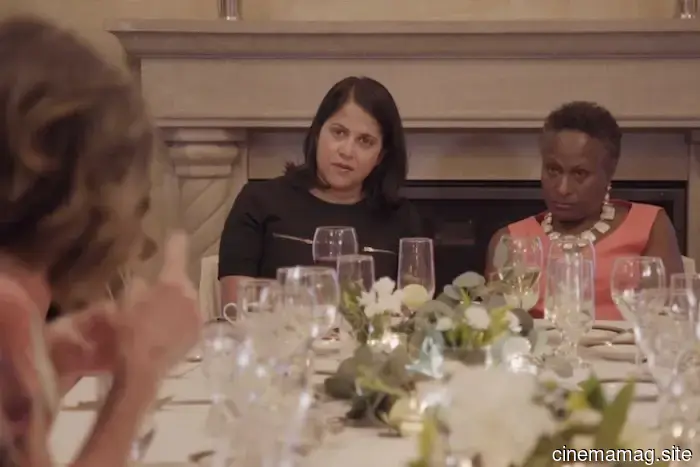
The Deconstructing Karen documentary offers straightforward discussions on race.
Regardless of how uncomfortable your next family get-together may be, we assure you it will be less uncomfortable than the dinner depicted in *Deconstructing Karen*, a new documentary that showcases a group of white women confronting a candid discussion about race—perfectly timed for the holiday season.
In the spring of 2019, the creators of *Deconstructing Karen* invited a group of white women from the Denver area to a dinner hosted by entrepreneurs Regina Jackson and Saira Rao. Their business, Race2Dinner, provides straightforward evaluations of racial attitudes. With cameras capturing the event, Rao, who is Indian-American, told the women, “white supremacy and racism is harmful to everyone, including white people,” to which the guests agreed. She then prompted everyone to introduce themselves. One woman expressed her desire for her children to grow up “colorblind.”
Another woman remarked, “My kids are biracial. My husband is Hispanic and white. So I don’t see color... I’m blinded to color. It doesn’t affect me at all. When we bleed, we bleed red.”
Shortly after, Rao addressed the group. “I’ve heard this a couple of times: Colorblindness, and that you don’t see color,” she stated. “And I’m just going to drop a bomb here: That’s white supremacy.” While Jackson nodded in understanding, many of the women appeared puzzled. “Colorblindness is white supremacy,” Rao reiterated.
Cue unsettling music as the bewildered mother of biracial children attempted to clarify her stance—welcome to *Deconstructing Karen*, directed by Patty Ivins Specht.
Interest in Race2Dinner surged when *The Guardian* published a February 2020 article titled “Why liberal white women pay a lot of money to learn over dinner how they’re racist.” After George Floyd’s murder sparked a wider reflection among white individuals regarding their behaviors and beliefs, Race2Dinner gained further exposure through an NBC segment on *Today*, noting that many of their dinners had transitioned to an online format due to COVID. By 2021, *TheCut* reported in an article titled “Guilty Parties” that the price for each dinner had increased from $2,500 to $5,000.
What *Deconstructing Karen* provides that earlier media coverage did not is the opportunity to observe a Race2Dinner session firsthand, capturing the often awkward dialogue that unfolds. Some exchanges feel groundbreaking, while others resemble a slow-motion accident—it’s hard to look away.
“As the filmmaker, I could have portrayed people in a more negative light,” Specht stated in an interview with MovieMaker. “I actually held back certain elements that I felt wouldn’t be fair to some participants, which I believe is significant, as my perspective is that it’s all subjective. What’s presented in the film is a fair and authentic representation of the events that occurred.”
Jackson, who is Black, cites her involvement in Civil Rights marches during the 1960s and her work on presidential campaigns as part of her credentials.
“Born in Chicago in 1950, Regina recalls an America defined by Black and white,” her biography on the Race2Dinner website notes. “She vividly remembers the beatings and atrocious treatment of civil rights activists throughout the south, the murders of Goodman, Chaney, and Schwerner, the slaying of Viola Liuzzo, the assassination of Martin Luther King, Jr., and the killings of President John Kennedy and his brother Robert. The violence inflicted on innocent individuals just going about their lives, by white people.”
In *Deconstructing Karen*, she explains that the focus on white women at Race2Dinner is due to their potential to drive change. “The demographic we've identified is white women who identify as liberal, progressive, or Democrat — not only to transform themselves but also to influence their children, families, coworkers, and friends. The weight of white supremacy and patriarchy is firmly on their necks, just as it is on ours,” Jackson states in the film.
Rao’s biography mentions that “for four decades, she squandered her valuable time yearning to be white and accepted by the dominant white society, a futile endeavor for anyone not born with white skin.” As a lawyer and published novelist, she also ran for Congress in 2018 but faced backlash due to a tweet. She shared a New York Times op-ed titled, “Should I Give Up On White People?” and replied, “Short and long answer: YES.” The intense backlash led her to subsequently leave Colorado due to death threats.
Some viewers might question various aspects of *Deconstructing Karen*: Does a woman claiming to be “colorblind” embody white supremacy, or is she merely attempting to convey goodwill in an awkward manner? Specht maintains that the film fosters important conversations about race that viewers might not engage in otherwise, regardless of whether they appreciate Rao and Jackson's style of communication.
“I’ve had many people tell me, ‘
Other articles
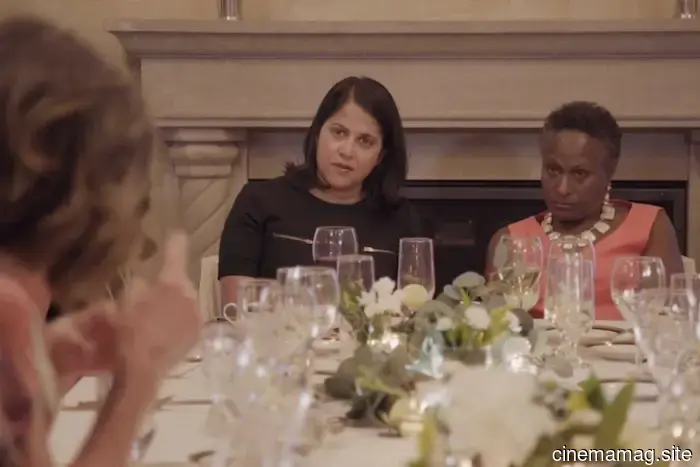 Deconstructing Karen Documentary Offers Candid Discussion on Race
Deconstructing Karen is a recent documentary featuring Saira Rao and Regina Jackson, the founders of Race2Dinner, who confront the viewpoints of white women regarding race.
Deconstructing Karen Documentary Offers Candid Discussion on Race
Deconstructing Karen is a recent documentary featuring Saira Rao and Regina Jackson, the founders of Race2Dinner, who confront the viewpoints of white women regarding race.
 10 Must-See Road Movies from the 1990s
Casey Chong showcases a significant collection of road movies from the 90s... The tropes of 1990s road films characterize the genre by emphasizing the characters' journeys of self-discovery along with a thought-provoking theme...
10 Must-See Road Movies from the 1990s
Casey Chong showcases a significant collection of road movies from the 90s... The tropes of 1990s road films characterize the genre by emphasizing the characters' journeys of self-discovery along with a thought-provoking theme...
 Images and trailer for season 2 of Transformers: Cyberworld are revealed prior to its YouTube debut.
As the second season of Transformers: Cyberworld is set to debut on the official Transformers YouTube channel this Saturday, a new trailer for the CG-animated series has been released online, showcasing the bots…
Images and trailer for season 2 of Transformers: Cyberworld are revealed prior to its YouTube debut.
As the second season of Transformers: Cyberworld is set to debut on the official Transformers YouTube channel this Saturday, a new trailer for the CG-animated series has been released online, showcasing the bots…
 The trailer and poster for the Japanese ghost story Never After Dark have been revealed.
Magnolia Pictures has released a trailer for the Japanese supernatural thriller Never After Dark, set to premiere this September. The story centers around Airi, a medium who assists wandering souls with the…
The trailer and poster for the Japanese ghost story Never After Dark have been revealed.
Magnolia Pictures has released a trailer for the Japanese supernatural thriller Never After Dark, set to premiere this September. The story centers around Airi, a medium who assists wandering souls with the…
 Trailer for the action thriller Ghost Soldier featuring Jim Caviezel.
Sony Pictures has released a trailer for Ghost Soldier, the forthcoming action thriller directed by William Eubank (The Signal, Underwater). The story revolves around Henry (Jim Caviezel), an enigmatic individual who attempts...
Trailer for the action thriller Ghost Soldier featuring Jim Caviezel.
Sony Pictures has released a trailer for Ghost Soldier, the forthcoming action thriller directed by William Eubank (The Signal, Underwater). The story revolves around Henry (Jim Caviezel), an enigmatic individual who attempts...
 Chris Pratt returns to action in the trailer for season 2 of The Terminal List.
Prime Video has unveiled a trailer for the second season of the espionage thriller series The Terminal List, starring Chris Pratt. The upcoming season is inspired by the second book in Jack Carr’s series of novels.…
Chris Pratt returns to action in the trailer for season 2 of The Terminal List.
Prime Video has unveiled a trailer for the second season of the espionage thriller series The Terminal List, starring Chris Pratt. The upcoming season is inspired by the second book in Jack Carr’s series of novels.…
The Deconstructing Karen documentary offers straightforward discussions on race.
"Deconstructing Karen" is a new documentary featuring Saira Rao and Regina Jackson, the founders of Race2Dinner, who confront white women's views on race.