
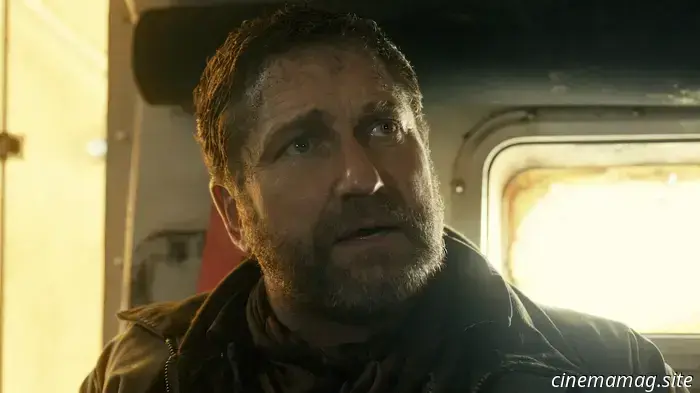
How Greenland 2: Migration Set Back Gerard Butler and Triggered a Devastating Earthquake
Greenland 2: Migration director Ric Roman Waugh has a background in stunts and understands what can be achieved through film magic and what cannot.
"I know what inertia entails, and it's impossible to fake inertia. Often, you have to execute it authentically," he states. "That's why we still perform real car crashes."
This dedication to authenticity led him to create a dramatic ceiling drop involving Gerard Butler and the cast of his upcoming post-apocalyptic film, which follows the Garrity family as they navigate a world threatened by comets. The movie premieres Friday.
"There is a true artistry to this," Waugh remarks, having worked on stunts for films such as Days of Thunder and The Last of the Mohicans before turning to writing and directing. "I was fortunate to have a talented team to execute everything correctly."
Among the team was visual effects supervisor Marc Massicotte, who examined global natural disasters to determine how to visually represent them on screen, enhancing their scale for a catastrophic global event. He even filmed a real volcanic eruption for the film's opening scene and analyzed footage from underground bomb tests for a bunker implosion sequence.
"I always begin by exploring reality," he shares. "What would this world actually be like if it were to occur?"
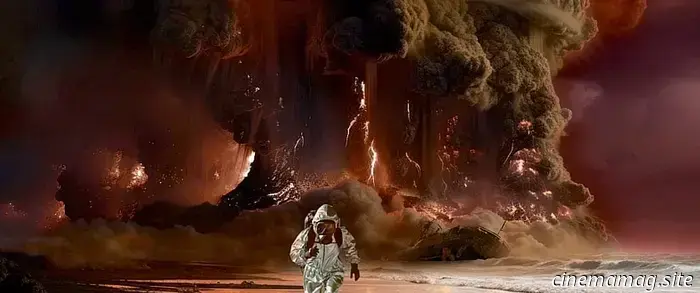
Concept art by Sean Samuels depicts a radioactive storm on the beach near the bunker in Greenland 2: Migration. Courtesy of Lionsgate.
Waugh has collaborated with Massicotte since their first project together on 2019’s Angel Has Fallen, the third installment in another franchise featuring Butler. Their approach to creating a believable world starts on set, with CGI used mainly to enhance what is captured naturally.
This philosophy shines through in the first act's explosive destruction of the Greenland bunker.
It serves as a crucial moment for the protagonists as they continue their struggle for survival in a world ravaged by comet impacts, both large and small. Audiences witnessed the most significant collision at the end of the first movie, when the Garrity family found refuge in a military-grade bunker just before a massive fragment struck southern France.
The sequel takes place five years later, with rumors suggesting the crater might harbor life in a dying world afflicted by radioactive storms, tidal waves, meteor showers, and civil unrest—among other challenges Butler's character, John Garrity, faces.
Once again, he is joined by Morena Baccarin as his wife, Allison, as they strive to protect their son, now portrayed by Roman Griffin Davis.
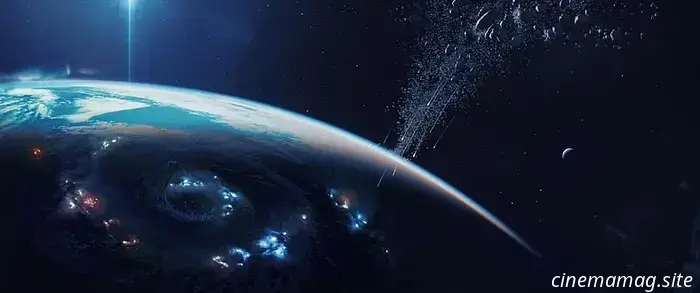
Concept art by Sean Samuels shows a ghost ring around the Earth post Clark comet impact in Greenland 2: Migration. Courtesy of Lionsgate.
The film's title and trailer indicate that the family adventures beyond Greenland this time, with the inciting incident being a seismic event that compels them to travel across land and sea. Although this segment lasts only a few minutes, Waugh mentions it required four months of preparation and two weeks of shooting, integrating meticulous set design, stunts, cinematography, CGI, and mechanical engineering.
"We accomplished everything practically on camera. It wasn’t a case of the camera shaking. The swaying lights and people being thrown were due to our shaker floor system," he clarifies.
Massicotte adds, "Many of us buckled at the knees and fell. Although it was designed to be safe, the unexpected movement still surprises you, which enhances the realism."
While Massicotte and his compositors used digital effects to “enhance” and “augment the impact,” most of the action was filmed in real-time.
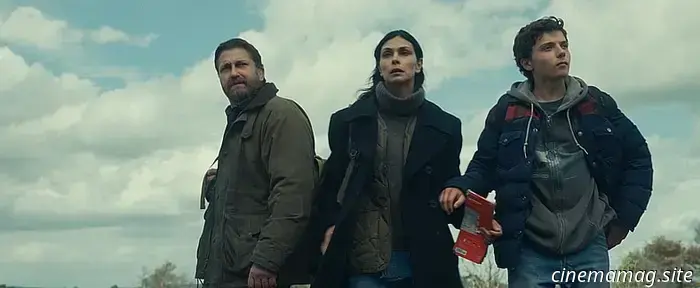
Gerard Butler as John Garrity, Morena Baccarin as Allison Garrity, and Roman Griffin Davis as Nathan Garrity in Greenland 2: Migration. Lionsgate.
Returning to the ceiling drop, production designer Vincent Reynaud and the team meticulously selected materials that could be safely dropped on cast members without causing injury or appearing cheap on camera.
Waugh explains, “We used everything from balsa wood to large foam pieces.”
Their months of discussions and tests focused on key questions: "How do you construct foam pieces to resemble steel girders or substantial chunks of concrete that don’t bounce or squash when they hit the ground?"
Waugh's preference for practical effects stemmed from a desire for genuine reactions from his actors.
"You don’t want a bunch of fake CGI stuff telling actors to 'pretend you’re collapsing with things falling around you.' It doesn’t work that way and comes across as unauthentic," he elaborates. "So we drop real items on people to ensure they can feel it and respond appropriately, while being careful not to injure anyone."
Concept art by Sean Samuels illustrates Clark’s crater in Greenland 2: Migration. Courtesy of Lionsgate.
The intricately designed chaos illustrates the importance of not disregarding mathematics and science in filmmaking.
"I advise my sons to focus in math and school, as we constantly deal with physics," Waugh shares. "We’re continually calculating to ensure safety while maximizing live-action content on screen."

Other articles
 Luke Hicks’ Best 10 Movies of 2025
After The Film Stage released its collective ranking of the top 50 films of 2025 as part of our year-end recap, our contributors are presenting their individual top 10 lists. To illustrate my year with one bizarre yet amusing incident: I fractured my hand in a moped accident on the final day of my coverage at the Cannes Film Festival, alongside the lesser-known power grid hack that
Luke Hicks’ Best 10 Movies of 2025
After The Film Stage released its collective ranking of the top 50 films of 2025 as part of our year-end recap, our contributors are presenting their individual top 10 lists. To illustrate my year with one bizarre yet amusing incident: I fractured my hand in a moped accident on the final day of my coverage at the Cannes Film Festival, alongside the lesser-known power grid hack that
 Netflix has released a new trailer for Agatha Christie's Seven Dials.
With just over a week remaining until Agatha Christie’s Seven Dials premieres on Netflix, the streaming service has released a new trailer for the mystery drama. The series centers around the unexpected detective, Lady Ei…
Netflix has released a new trailer for Agatha Christie's Seven Dials.
With just over a week remaining until Agatha Christie’s Seven Dials premieres on Netflix, the streaming service has released a new trailer for the mystery drama. The series centers around the unexpected detective, Lady Ei…
 Sebastian Stan joins the cast of The Batman Part II, featuring Robert Pattinson and Scarlett Johansson.
From the Avengers to Gotham City, Matt Reeves’ highly anticipated The Batman Part II has now welcomed Sebastian Stan to its expanding cast. Stan is famously recognized for portraying Bucky Barnes/Winter…
Sebastian Stan joins the cast of The Batman Part II, featuring Robert Pattinson and Scarlett Johansson.
From the Avengers to Gotham City, Matt Reeves’ highly anticipated The Batman Part II has now welcomed Sebastian Stan to its expanding cast. Stan is famously recognized for portraying Bucky Barnes/Winter…
 Mickey Rourke Turns Down 'Humiliating' GoFundMe Campaign to Prevent Eviction.
Mickey Rourke has turned down a GoFundMe campaign that gathered over $100,000 to help stop his eviction from his residence in West Hollywood.
Mickey Rourke Turns Down 'Humiliating' GoFundMe Campaign to Prevent Eviction.
Mickey Rourke has turned down a GoFundMe campaign that gathered over $100,000 to help stop his eviction from his residence in West Hollywood.
 Mayor of Kingstown has been renewed for its fifth and final season.
Taylor Sheridan's crime drama, Mayor of Kingstown, has been picked up for a fifth and final season at Paramount+, although it will have a reduced number of episodes. The series, starring Jeremy Renner, recently concluded...
Mayor of Kingstown has been renewed for its fifth and final season.
Taylor Sheridan's crime drama, Mayor of Kingstown, has been picked up for a fifth and final season at Paramount+, although it will have a reduced number of episodes. The series, starring Jeremy Renner, recently concluded...
 A Restored Gem by Luchino Visconti Unveiled in Exclusive Trailer for Conversation Piece
One of the most enlightening retrospectives I had the chance to attend was focused on Luchino Visconti, held in 2018 at Film at Lincoln Center. With 14 features, his body of work truly deserves to be seen on the big screen, and now one of his lesser-known treasures has been restored in 4K and will be
A Restored Gem by Luchino Visconti Unveiled in Exclusive Trailer for Conversation Piece
One of the most enlightening retrospectives I had the chance to attend was focused on Luchino Visconti, held in 2018 at Film at Lincoln Center. With 14 features, his body of work truly deserves to be seen on the big screen, and now one of his lesser-known treasures has been restored in 4K and will be
How Greenland 2: Migration Set Back Gerard Butler and Triggered a Devastating Earthquake
Greenland 2: Migration director Ric Roman Waugh has a background in stunts and understands the feats achievable through cinematic techniques as well as the limitations.