
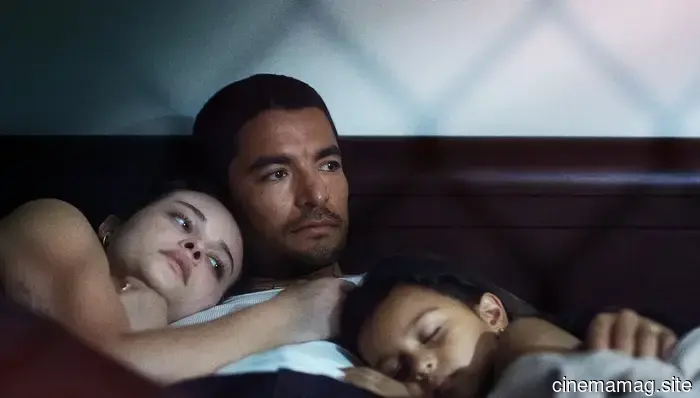
In Melissa Fisher's 'Inside These Walls,' a family strives for a sense of normalcy in the face of incarceration.
A relationship that could not continue motivated Melissa Fisher to create “Inside These Walls.”
This poignant short film examines the diminishing practice of allowing extended family visitations in prisons, where inmates can connect with their loved ones in specially designed apartments located on the prison grounds. Once known as conjugal visits, such options have largely been eliminated across the country. The film premiered this week at the deadCenter Film Festival in Oklahoma City.
“‘Inside These Walls’ started as a personal reflection on a relationship limited by circumstances: a deep love that was ultimately not viable,” Fisher explains. “I thought it would be intriguing to express this relationship through the lens of prison visitation. I envisioned a conjugal visit—an intensely literal representation of enforced separation—and determined that this could be a powerful approach to exploring love and loss.”
Directed by Fisher and co-written with Jonathan Clark, the film features Isabella Briggs as Ava, who dutifully visits the imprisoned Isaac (Bobby Soto) alongside their daughter (Natalia Esquivias). The performances beautifully encapsulate the delicate rituals of people attempting to embrace the simple pleasures of normal family life for a few fleeting hours before returning to the sorrow of separation.
Anyone who has experienced a long-distance relationship and felt time slipping away during brief weekends together will resonate with this. Moreover, the film encourages deeper reflection on the purpose of incarceration: whether it aims to reintegrate inmates into society or simply to keep them away.
Produced by Katie Gunderson and Heather Brawley, who also produced the noteworthy short “Princeton’s In the Mix,” which similarly uses a personal narrative to address larger issues of fairness, “Inside These Walls” is a significant project.
Fisher, who has contributed to projects like La La Land and GLOW, recently created the touching short “Buscando Alma,” a drama about a Honduran immigrant reuniting with her mother after nearly twenty years apart, marked by profound transformation. She shared her insights on family, justice, and the challenge of making her “Inside These Walls” locations resemble an authentic prison.
Bobby Soto and Isabella Briggs in “Inside These Walls”
MovieMaker: What inspired you to create a film about extended family visitations?
Melissa Fisher: As I began my research into modern conjugal visits (now termed family visits), I discovered that only four states in the U.S. still permit them. I questioned why such programs were not more widely available. Allowing inmates the opportunity to maintain healthy family connections seems vital for rehabilitation and reintegration into society.
I believed that this film could illuminate an aspect of incarceration that is seldom seen or discussed. I cherish moments when I can uncover a deeper significance for a project, where the themes resonate beyond my own experiences and provoke more significant questions about our shared society.
MovieMaker: How did you manage the challenging task of setting this story within prison walls? Did you film in an actual prison?
Melissa Fisher: Filming in an active prison was unfeasible due to cost and logistical difficulties. After months of searching, we discovered a decommissioned juvenile hall in L.A. County that closed in 2023. The staff who still oversee the facility were incredibly accommodating and permitted us to utilize the authentic spaces we required.
One remarkable aspect of this experience was our collaboration with the Anti-Recidivism Coalition, a non-profit based in L.A. that supports individuals who have been incarcerated. Some crew members and background extras involved in the project had previously served time at that juvenile hall, providing a meaningful full-circle moment for them.
MovieMaker: You mention in the film's postscript that extended family visits have been halted in all but four states. Why was it important for you to include this information? Do you view the film as an advocacy piece for these visits?
Melissa Fisher: It is well-known that we face a prison crisis in this country. The United States comprises only 5% of the global population yet holds nearly 25% of the world’s prisoners. Clearly, we've built a system that prioritizes punishment over rehabilitation.
I hope this film advocates for greater access to extended family visits and highlights the need for more restorative justice initiatives. In 1993, 17 states had family visit programs; by 2015, that number dwindled to just four. However, research indicates that such visitation programs have significant benefits not only for those incarcerated but also for society as a whole, reflected in lower crime rates. The postscript offers essential context and encourages viewers to contemplate the real-life implications of how our prison system treats incarcerated individuals and their families.
MovieMaker: How did you assemble your outstanding cast for “Inside These Walls”?
Melissa Fisher: We were fortunate to collaborate with the exceptionally talented Amber Wakefield as our casting director. This collaboration led us to the remarkable Isabella Briggs, who had just finished working on The Summer I Turned Pretty. Isabella is based in New York, and we initially connected over Zoom. I was impressed with her thorough preparation, and I found

Other articles
 Top 5 Online Casinos for Pokies in Australia for 2026 | Endorsed by Australian Players - MovieMaker Magazine
The online gaming market in Australia has grown extremely competitive, with only a handful of casinos really distinguishing themselves. Modern players seek more than just bonuses;
Top 5 Online Casinos for Pokies in Australia for 2026 | Endorsed by Australian Players - MovieMaker Magazine
The online gaming market in Australia has grown extremely competitive, with only a handful of casinos really distinguishing themselves. Modern players seek more than just bonuses;
 Marvel's X-Men '97 Season 2 has released a trailer featuring its cast.
With under three weeks remaining until the eagerly awaited return of X-Men '97, Marvel has released a roll call trailer for the second season of the revival of X-Men: The Animated Series, which featured…
Marvel's X-Men '97 Season 2 has released a trailer featuring its cast.
With under three weeks remaining until the eagerly awaited return of X-Men '97, Marvel has released a roll call trailer for the second season of the revival of X-Men: The Animated Series, which featured…
 Lady Jaye, Deep Six, Zartan, and the Cobra Viper Gunner are set to be part of Super7's G.I. Joe: A Real American Hero ReAction+ series.
Super7 has officially announced wave 9 of its G.I. Joe: A Real American Hero ReAction+ series, featuring new retro-inspired O-ring action figures for Zartan, Deep Six, Lady Jaye, and the Cobra Viper…
Lady Jaye, Deep Six, Zartan, and the Cobra Viper Gunner are set to be part of Super7's G.I. Joe: A Real American Hero ReAction+ series.
Super7 has officially announced wave 9 of its G.I. Joe: A Real American Hero ReAction+ series, featuring new retro-inspired O-ring action figures for Zartan, Deep Six, Lady Jaye, and the Cobra Viper…
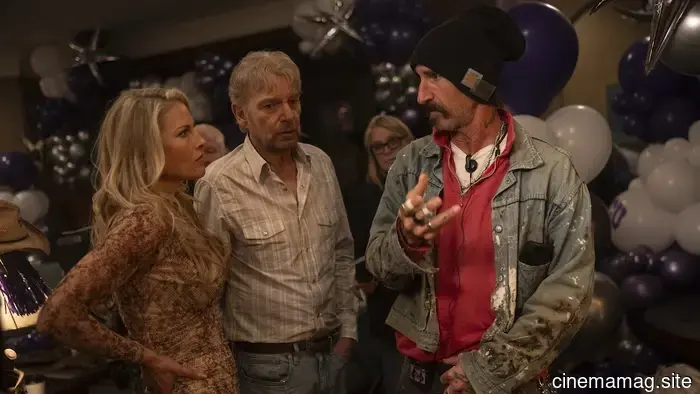 Stephen Kay on Directing the Entire Second Season of Landman
Stephen Kay, the primary director of Landman, has a wealth of experience in television and film. He describes the distinction in this way: In a television show, you generally...
Stephen Kay on Directing the Entire Second Season of Landman
Stephen Kay, the primary director of Landman, has a wealth of experience in television and film. He describes the distinction in this way: In a television show, you generally...
In Melissa Fisher's 'Inside These Walls,' a family strives for a sense of normalcy in the face of incarceration.
Filmmaker Melissa Fisher discusses the inspiration behind her film "Inside These Walls," which focuses on visits from extended family members to incarcerated individuals.