
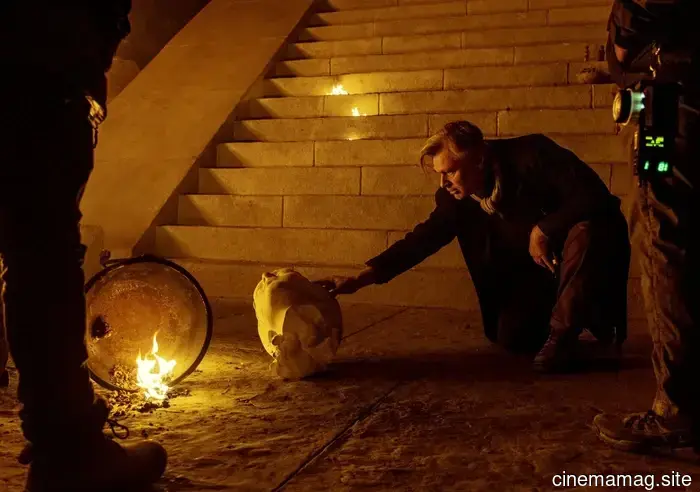
Christopher Nolan discusses the shortcomings of film criticism and the common philosophical themes between Oppenheimer and The Odyssey.
If you're feeling fatigued by the plethora of interviews featuring The Odyssey team discussing their experiences filming with IMAX cameras or striving for practical effects, a new opportunity has emerged. During his promotional tour in Beijing for his box office giant, Christopher Nolan engaged in an extensive and captivating conversation with political philosophy lecturer and doctoral candidate Zhong Shu about the creation of his adaptation of Homer.
Known for sometimes being elusive––or perhaps not sufficiently probed––regarding the philosophical choices in his films, Nolan was prompted by Zhong Shu to share his insights on “Christianizing” Homer’s epic, the themes of atonement within the film, his views on the shortcomings of film criticism (refer to our less-than-positive review of his recent work), breaking narrative conventions, his depiction of the gods, and more.
In discussing the adaptation and the concept of historical distance, Nolan notes, “The key issue is the approximately 400-year gap between the events Homer describes and the time when his narrative was recorded or first shared with audiences. That’s a fascinating gap. Personally, I don’t believe I diverge entirely from Homer’s storytelling when viewed through a historical lens. The reason is that Homer writes about a time long before his audience, which they perceived as more advanced than their own. Therefore, while they were a civilization on the rise, they were actually trying to return to the heights of a past civilization that existed 400 years prior.”
“That notion of a cycle—the concept of a civilization at dusk—is subtly present in the past. Historical evidence shows that when they excavated the remnants of ancient palaces that had fallen apart, they referred to them as ‘Cyclopean walls’ because they believed only giants could have constructed such grand structures. They held a view of an impressive former civilization. My interest lies in that collapse—what they refer to as the ‘catastrophe’ of the Bronze Age—and the events that transpired between the Trojan War and Homer's time. From a contemporary viewpoint, this is both daunting and intriguing. My work on Oppenheimer before this further influenced my approach, as it is a film focused on the end of the world and the disintegration of civilization. I certainly brought that perspective into my adaptation of The Odyssey.”
When asked about incorporating the concept of “atonement,” which lacks a presence in Greek culture and could be seen as “Christianizing” The Odyssey, Nolan explained, “I wasn’t overly aware of my philosophical approach, other than that I focused on the notion of xenia. In the film, we simplify this to ‘Zeus’s Law,’ which revolves around the idea of mutual respect—treating others as you wish to be treated. In their belief system, this is crucial because a stranger might be a god in disguise. I delved deeply into that and came to understand that much of what fascinates me about the interplay of history and mythology involves the ‘Sea Peoples’—the maritime people believed to have triggered the Bronze Age collapse. This remains one of history’s great mysteries: who were they?”
He added, “The violation of xenia—a breach of Zeus’s Law, exemplified by the suitors in the palace—creates disruption and chaos. I think the idea of atonement, to some extent, is what we, as viewers, contribute to the story. I’m uncertain if true atonement exists within the film, or whether we merely perceive a catharsis in the long-awaited reunion between Odysseus and Penelope. In that regard, our modern sensibilities might be influencing that interpretation. Where it appears, it isn’t a conscious effort to Christianize the narrative; instead, it’s a natural conclusion stemming from my exploration of the philosophical implications of breaking Zeus’s Law.”
Reflecting on Odysseus's potential repentance for his hubris, Nolan remarked, “One could inquire: what difference would his repentance make? This touches on the intriguing aspects of these philosophical considerations. His repentance would remain internal, solely for his spiritual fulfillment. It wouldn’t change the external consequences since the harm is already inflicted. Xenia has been compromised, possibly irreparably. That’s the tragic aspect of hubris—it's fundamentally irreversible. While Christian theology might interpret this differently, in practical terms, it does not alter the past. Thus, in narrative terms, it's not necessarily relevant. As I mentioned, our understanding shapes our experience, leading us to feel catharsis due to the honesty and intimacy present between Odysseus and Penelope, which I find emotionally significant. However, if his repentance has no tangible impact and the disaster is inevitable—the collapse is coming—then what significance does it hold for the unfolding events? Are we focused on his spiritual condition or on the world he inhabits that he believes has been damaged?”
After moving from Oppenheimer to The Odyssey, both narratives featuring “great” men undergoing a form of repentance, Nolan shared insights about his method and the critique surrounding it
Other articles
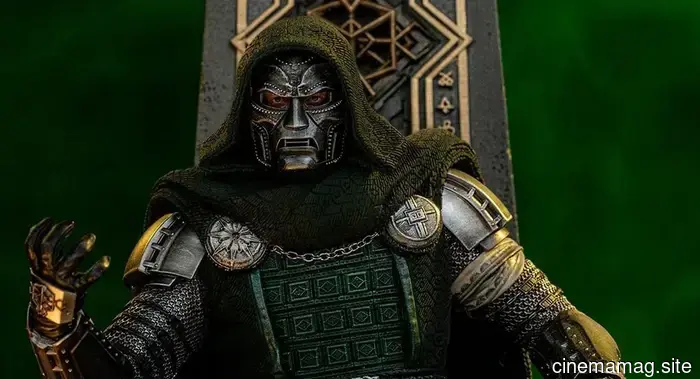 Iron Studios has revealed the Avengers: Doomsday Doctor Doom on Throne Art Scale Statue.
After presenting their Professor X and Magneto collectibles, Iron Studios has revealed yet another Art Scale statue for the upcoming December blockbuster Marvel Studios film, Avengers: Doomsday, featuring ‘D…
Iron Studios has revealed the Avengers: Doomsday Doctor Doom on Throne Art Scale Statue.
After presenting their Professor X and Magneto collectibles, Iron Studios has revealed yet another Art Scale statue for the upcoming December blockbuster Marvel Studios film, Avengers: Doomsday, featuring ‘D…
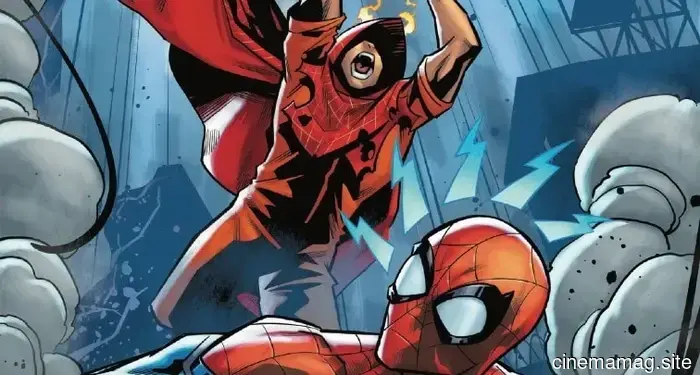 Comic Book Preview – The Origins of the Hood: Marvel Rivals #1
This Wednesday, Marvel Comics explores Parker Robbins' origin story in Origins of the Hood: Marvel Rivals #1, and you can check out an early sneak peek with the official preview below...
Comic Book Preview – The Origins of the Hood: Marvel Rivals #1
This Wednesday, Marvel Comics explores Parker Robbins' origin story in Origins of the Hood: Marvel Rivals #1, and you can check out an early sneak peek with the official preview below...
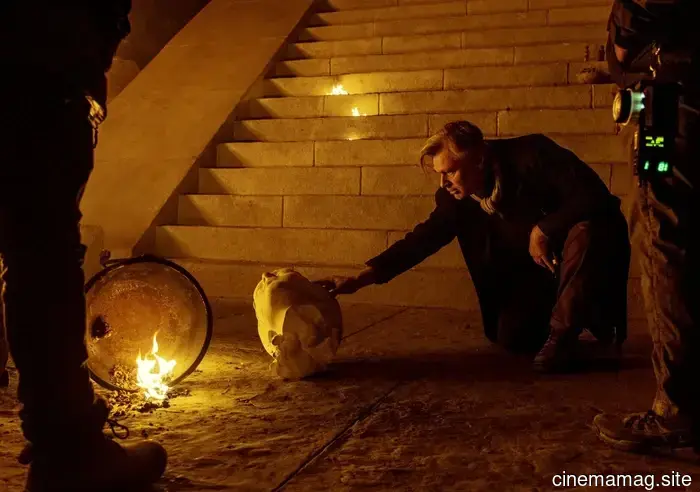 Christopher Nolan discusses the shortcomings of film criticism and explores the common philosophical themes found in both Oppenheimer and The Odyssey.
If you’ve become weary of hearing the hundredth interview with The Odyssey team about filming entirely with IMAX cameras or about their efforts to capture everything as practically as they could, a blessing has now come your way. While on the press tour in Beijing for his box office giant, Christopher Nolan
Christopher Nolan discusses the shortcomings of film criticism and explores the common philosophical themes found in both Oppenheimer and The Odyssey.
If you’ve become weary of hearing the hundredth interview with The Odyssey team about filming entirely with IMAX cameras or about their efforts to capture everything as practically as they could, a blessing has now come your way. While on the press tour in Beijing for his box office giant, Christopher Nolan
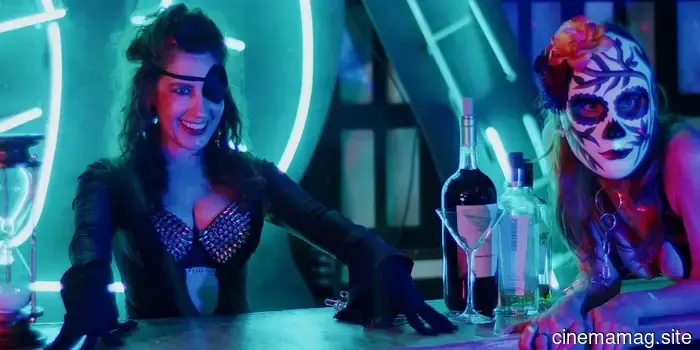 A beer-drinking witch confronts the powers of Hell in the trailer for Blood Magick.
Freestyle Digital Media has released a trailer for Blood Magick, a new horror film by writer-director Micah Delhauer, set to be available on VOD this month. It features performances by Frances Parsons, Victoria de Mare, and Laura Delhauer…
A beer-drinking witch confronts the powers of Hell in the trailer for Blood Magick.
Freestyle Digital Media has released a trailer for Blood Magick, a new horror film by writer-director Micah Delhauer, set to be available on VOD this month. It features performances by Frances Parsons, Victoria de Mare, and Laura Delhauer…
.jpg) 4K Ultra HD Critique – The 7th Voyage of Sinbad (1958)
The 7th Voyage of Sinbad, released in 1958, is directed by Nathan Juran and features Kerwin Mathews, Kathryn Grant, Richard Eyer, and Torin Thatcher. SYNOPSIS: The 7th Voyage of Sinbad has its 4K Ultra HD premiere, showcasing...
4K Ultra HD Critique – The 7th Voyage of Sinbad (1958)
The 7th Voyage of Sinbad, released in 1958, is directed by Nathan Juran and features Kerwin Mathews, Kathryn Grant, Richard Eyer, and Torin Thatcher. SYNOPSIS: The 7th Voyage of Sinbad has its 4K Ultra HD premiere, showcasing...
Christopher Nolan discusses the shortcomings of film criticism and the common philosophical themes between Oppenheimer and The Odyssey.
If you’ve become weary of hearing the Odyssey team's countless interviews about their experiences filming entirely with IMAX cameras or their efforts to capture everything as practically as possible, a divine surprise has now come your way. While on the Beijing press tour for his blockbuster, Christopher Nolan