

Bitter Christmas Review: Pedro Almodóvar Delves Into His Creative Journey Through Soothing Metafiction
Bitter Christmas indicates that Pedro Almodóvar has entered his later period, returning to the metafiction theme for yet another structurally ambitious examination of the creative process, featuring at least one character who bears a slight resemblance to him. While this may not be anyone's top Almodóvar film, it does provide some simple pleasures, potentially marking it as the quintessential Almodóvar. Its dissection of a director's writing habits feels oddly reassuring, despite its attempts to unsettle viewers with each revelation of new layers in its character perspectives, akin to a Russian doll. An autofictional investigation of creation has been a continuing theme since 1995’s The Flower of My Secret, with 2019’s Pain and Glory serving as a definitive exploration in this vein, showcasing his most overt director surrogate to date (Antonio Banderas’ Salvador Mallo) and directly addressing various chronic issues that have influenced his work. His latest offering does not present a new and profound viewpoint that warrants revisiting such similar themes; the familiarity of this focus lends it a more superficial pleasure rather than another groundbreaking insight into how a master filmmaker draws inspiration.
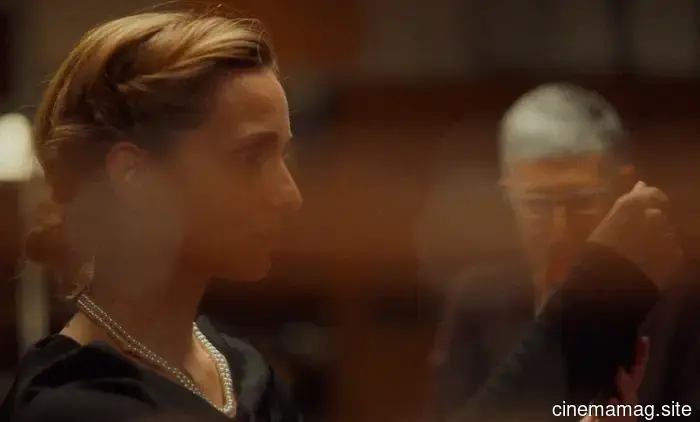
Bitter Christmas spans the years 2004 to 2025, introducing the semi-retired director Elsa (Bárbara Lennie) during the earlier timeframe as she arrives at a hospital suffering from debilitating migraines, which serves as a clear hint to consider her as an Almodóvar surrogate. A filmmaker who had crafted two cult films a decade earlier, she becomes introspective after being admitted to a ward featured in a hospital drama she had created, requesting a room change due to the death of a character from that setting. After realizing she is experiencing a series of prolonged panic attacks and has found the right treatment, a meeting with a therapist uncovers her struggle with unresolved trauma stemming from her failure to take time off work to grieve her mother’s death a year prior. She soon reconnects with two very different friends––Patricia (Victoria Luengo), whose husband is having an affair, and Natalia (Melena Smit), whose young son died in a car accident while she was driving––and finds her writer's block lifted, as their shared experiences begin to influence the narrative of her next project.
That narrative is, of course, the film within the film, written with what appears to be deliberate chaos. Whether one has the patience to endure this self-indulgent segment that comprises much of the runtime—which visualizes what is clearly a poorly constructed, narratively underdeveloped screenplay by the primary director proxy Raúl (Leonardo Sbaraglia)—depends on how much personal affection one holds for Almodóvar's previous works. He critically examines a director’s responsibility in integrating others’ stories into a work of autofiction but saves overt self-criticism for later in the drama. For the most part, Bitter Christmas' film-within-a-film operates straightforwardly with minimal interruptions from the director who writes it; this familiarity resonates as another of Almodóvar’s modern takes on a Sirkian women’s film, though it struggles to escape its own slightness, despite the minor nature of this work being part of a larger design.
With its quick shifts between time periods, indulgent interludes of male stripteases, and needle drops of the director’s cherished Chavela Vargas, and without providing satisfying conclusions to many of its longstanding character arcs, it resembles a filmed first draft. It brushes on a director’s various obsessions without weaving them into anything as emotionally compelling as his finest work. The rough quality implies that we are witnessing Raúl's writing as it flows onto the page, with fleeting interstitial shots of him at his laptop reinforcing that we are observing someone in the throes of creative inspiration, without a clear end in sight.
Almodóvar is an exceptional writer and a naturally skilled collaborator with actors, making the experience of viewing what feels like one of his rough drafts more engaging than that of many directors, even though we are dealing with a script that is deliberately chaotic. The uneven focus on Elsa and Raúl means that the film’s most critical observations regarding the creative process––the director has referred to it as “the film where I’ve been the cruelest to myself” in interviews––are less impactful, filtered through the comparatively lightweight character drama rather than afforded the space to breathe. The third act, where both narratives converge to create a more unified commentary on artistic responsibility, elicits more humor in its satire of an irresponsible director than it does insight, primarily because the movie seems crafted to justify every critique made by his former assistant Monica (Aitana Sánchez-Gijón).
Perhaps that is why Bitter Christmas serves better as a comforting Almodóvar film than as a more intense or cynical examination of the artistic process. Despite its purposeful slightness—an approach few filmmakers manage to transform into something enjoyable—it feels more like a feature-length build-up to a punchline rather than a probing
Other articles
 No Other Land Team Returns with Naza, Supported by Jonathan Glazer, Added to Venice and NYFF Programs.
Two of the directors responsible for the most important and crucial documentary of 2024, No Other Land (which won the Academy Award for Best Documentary and the Indie Film Site Network Advocate Award), are coming back with another exploration of the destruction and violence faced by Palestinian lives. The 83rd Venice International Film Festival has revealed that Naza, a new project by Yuval Abraham and Rachel Szor, will…
No Other Land Team Returns with Naza, Supported by Jonathan Glazer, Added to Venice and NYFF Programs.
Two of the directors responsible for the most important and crucial documentary of 2024, No Other Land (which won the Academy Award for Best Documentary and the Indie Film Site Network Advocate Award), are coming back with another exploration of the destruction and violence faced by Palestinian lives. The 83rd Venice International Film Festival has revealed that Naza, a new project by Yuval Abraham and Rachel Szor, will…
.jpg) Film Review – Buddy (2026)
Buddy, 2026. penned and helmed by Casper Kelly. Featuring performances by Cristin Milioti, Delaney Quinn, Patton Oswalt, Michael Shannon, Topher Grace, Madison Skyy Polan, and Keegan-Michael Key. SYNOPSIS: Within t…
Film Review – Buddy (2026)
Buddy, 2026. penned and helmed by Casper Kelly. Featuring performances by Cristin Milioti, Delaney Quinn, Patton Oswalt, Michael Shannon, Topher Grace, Madison Skyy Polan, and Keegan-Michael Key. SYNOPSIS: Within t…
 Exclusive Trailer for Venice Premiere Anatomy of a Portrait Showcases a Bold Visionary
Highlighting the groundbreaking vision of Fernanda Wittgens, Italy's first female museum director, Francesco Clerici and Mattia Colombo's Anatomy of a Portrait is scheduled to premiere at Giornate degli Autori during the Venice Film Festival. In anticipation of this event, we are excited to exclusively present the film's first trailer.
Exclusive Trailer for Venice Premiere Anatomy of a Portrait Showcases a Bold Visionary
Highlighting the groundbreaking vision of Fernanda Wittgens, Italy's first female museum director, Francesco Clerici and Mattia Colombo's Anatomy of a Portrait is scheduled to premiere at Giornate degli Autori during the Venice Film Festival. In anticipation of this event, we are excited to exclusively present the film's first trailer.
Bitter Christmas Review: Pedro Almodóvar Delves Into His Creative Journey Through Soothing Metafiction
Bitter Christmas indicates that Pedro Almodóvar has entered the later phase of his career, revisiting metafiction for another structurally bold exploration of the creative process, featuring at least one character who resembles him to some extent. It may not be anyone's top choice for an Almodóvar film, but it provides some modest pleasures as it could be.