
Shattering Silence Through Space: Lingwei Xiong’s Production Design in The School Uniform, Awarded at Warsaw -
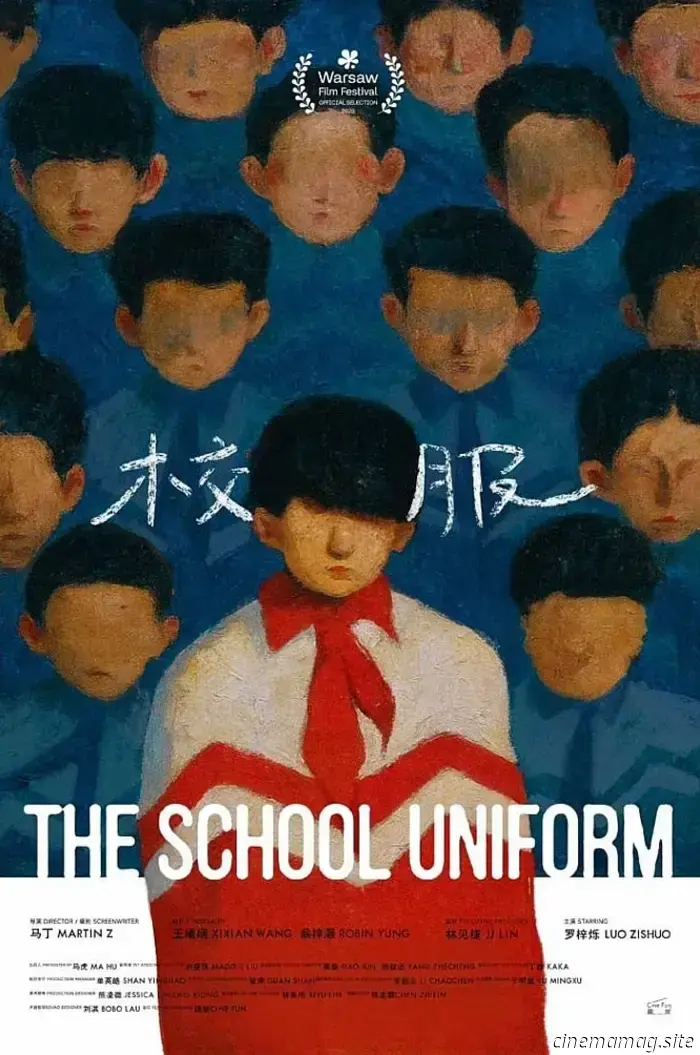
At the 41st Warsaw International Film Festival in October 2025, The School Uniform, helmed by Martin Z, was awarded Best Live-Action Short Film in the Short Film Competition. As an event recognized by FIAPF, the festival is celebrated for its support of cinema that is both formally precise and socially conscious. The jury commended the film for “narrating a multi-layered coming-of-age tale with subtlety, using a strong and mature cinematic language.”
Integral to this cinematic language is the film's visual and spatial design, crafted by production designer Lingwei Xiong. Featuring minimal dialogue and a restrained pace, the film leverages spatial rhythm and visual composition to convey what remains unarticulated.
Set in the 1990s in southern China, the story follows a young boy who is mistakenly perceived as a girl and compelled to don a red girls’ uniform leading up to a school arts performance. As he navigates a bustling family restaurant that doubles as his home and a school characterized by discipline and display, he learns to maintain silence amidst pressure, misidentification, and subtle humiliation—until that silence is ultimately shattered.
Space as Narrative Structure
Rather than overt conflict, the film expresses themes of oppression, shame, and identity anxiety through the visual tension present in the spatial design. Xiong states, “Instead of viewing the sets as neutral backgrounds, I aimed for each space to act as an active narrative force—one that regulates movement, conveys emotion, and imposes pressure—allowing meaning to emerge where words are absent.”
The School Uniform unfolds predominantly across two main settings: a small family restaurant that also serves as home, and a public school defined by order and routine.
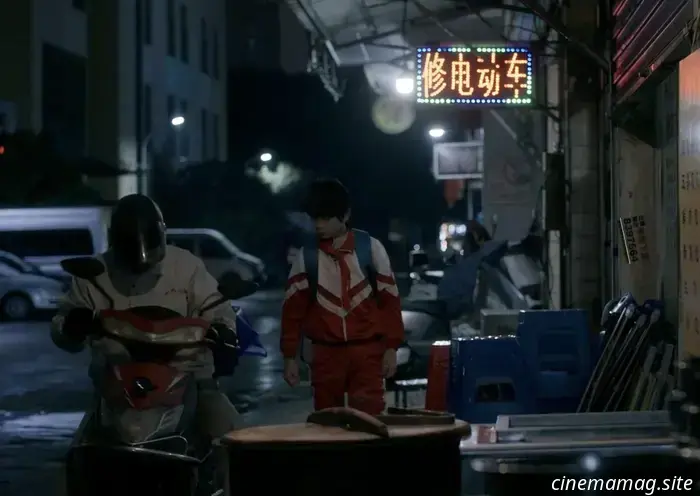
In the home environment, space is dense and perpetually disrupted. Furniture clutters the frame, work overlaps with personal life, and the boy completes his homework wherever he can find a surface, such as a shared table in the restaurant. The setting shows signs of everyday labor—grease-stained surfaces, aging posters, and layers of use accumulated over time. Warm hues are present, yet comfort is elusive. The overall atmosphere feels worn and subtly oppressive.
Xiong predominantly worked with real locations. She reorganized the existing layout, adjusted actors' movements, and curated secondhand furniture and everyday objects from local markets. Each item was intentionally selected and aged to appear lived-in, enhancing a sense of familiarity that offers no escape.
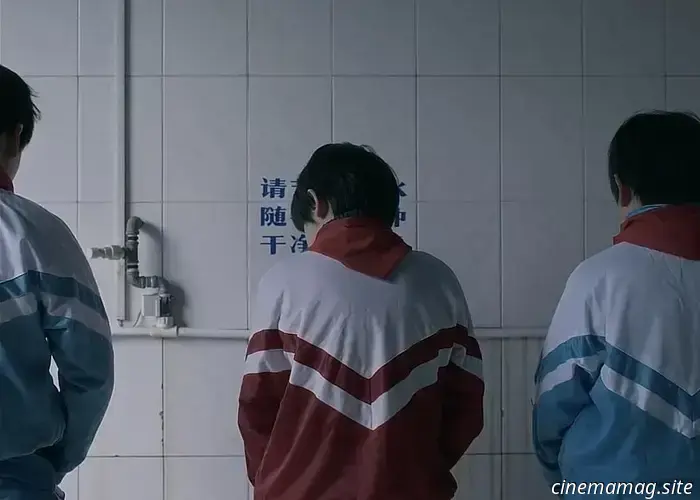
The school presents a contrasting restraint. Classrooms and hallways are pale, symmetrical, and distinctly orderly, adorned with slogans and institutional graphics that emphasize discipline over care. Movement is controlled, individual expression stifled, and silence subtly enforced. Misidentified and socially isolated, the boy navigates school under constant anxiety—often running late to class, dreading the boys’ restroom, and burdened by minor humiliations he lacks the language to articulate.
As director Martin Z notes, “Through textured set design and a balance of warm and cool tones, the production design faithfully recreates the ambiance of southern Chinese cities in the 1990s, lending the film a unique sense of nostalgia.” Despite their visual differences, both environments exert a comparable pressure, leaving minimal space for privacy, self-expression, or emotional release.
Color, Control, and the Stage
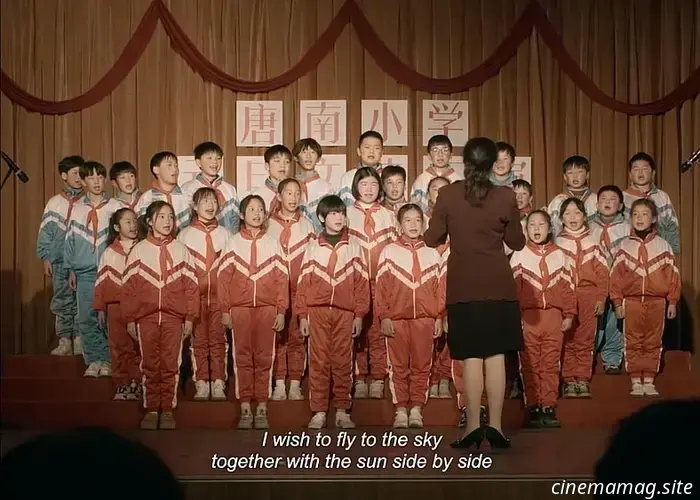
The film's most striking visual motif is the red and blue school uniforms—assigned markers of identity rather than ones chosen. Xiong intentionally suppresses the surrounding color palette, allowing these two colors to stand out with unsettling clarity.
This visual narrative culminates in the school's arts performance. The stage discards all restraint: gold curtains, red banners, ribbons, and harsh lighting overwhelm the space. What should be a celebratory occasion becomes excessive. The choreography is orderly, smiles are rehearsed, and, under the bright lights, individuality fades into sameness. Here, color ceases to represent vitality or joy—it increases visibility while denying agency. The stage represents the film's most rigid visual moment, establishing the conditions for what follows.
Fire as Interruption
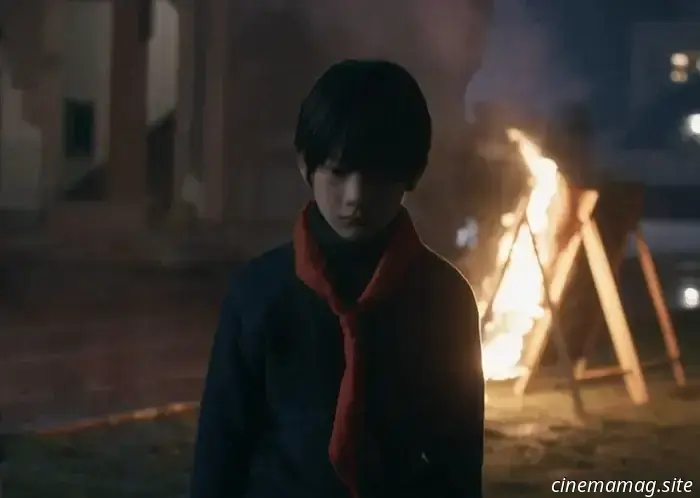
The final scene quietly interrupts the narrative. At the film's emotional climax following the stage performance, the boy removes his red school uniform and tosses it into the arts-performance poster he has just ignited. The fire is contained yet sufficient to illuminate both the schoolyard and the unspoken truths.
Xiong does not depict this moment as an act of violence or destruction. “I don’t view the fire as an explosion,” she states. “The film’s narrative is delicate and empathetic; it isn't centered on fierce resistance or anger. It encourages contemplation of growth, identity, order, and self-expression. The fire serves as a substitution for language—it momentarily disrupts an assumed order and opens a path for a previously silent character.”
To realize this moment, Xiong and her team experimented with various materials and ignition methods beforehand, meticulously controlling the fire's appearance on screen to feel intentional rather than chaotic. In a film where constraint regulates both
Other articles
 Comic Book Sneak Peek – Batman #5
DC Comics is set to release Batman #5 on Wednesday, and we have the official preview of the issue for you below; take a look… A night out with Bruce Wayne quickly takes a turn for the worse for Dr. Annika Ze…
Comic Book Sneak Peek – Batman #5
DC Comics is set to release Batman #5 on Wednesday, and we have the official preview of the issue for you below; take a look… A night out with Bruce Wayne quickly takes a turn for the worse for Dr. Annika Ze…
 8 Disturbing Neighbor Films for Your Viewing List
Casey Chong presents eight excellent creepy neighbor films to add to your watchlist. There's a captivating quality to examining the myriad possibilities surrounding neighbors in a film, often in...
8 Disturbing Neighbor Films for Your Viewing List
Casey Chong presents eight excellent creepy neighbor films to add to your watchlist. There's a captivating quality to examining the myriad possibilities surrounding neighbors in a film, often in...
 The third wave of Masters of the Universe Origins 200x figures includes Prince Adam, Skeletor, Zodak, and Clawful.
Mattel has officially begun taking pre-orders for the third wave of Masters of the Universe Origins 200x action figures, which includes Prince Adam inspired by his look in the episode “The Courage…
The third wave of Masters of the Universe Origins 200x figures includes Prince Adam, Skeletor, Zodak, and Clawful.
Mattel has officially begun taking pre-orders for the third wave of Masters of the Universe Origins 200x action figures, which includes Prince Adam inspired by his look in the episode “The Courage…
 Comic Book Sneak Peek – Tim Burton’s The Nightmare Before Christmas: The Shiver of Christmas Town #1
Dynamite Entertainment is set to release its new ongoing series, Tim Burton’s The Nightmare Before Christmas: The Shiver of Christmas Town, this Wednesday. You can catch an early glimpse of the first...
Comic Book Sneak Peek – Tim Burton’s The Nightmare Before Christmas: The Shiver of Christmas Town #1
Dynamite Entertainment is set to release its new ongoing series, Tim Burton’s The Nightmare Before Christmas: The Shiver of Christmas Town, this Wednesday. You can catch an early glimpse of the first...
 Prime 1 Studio has revealed the Marcus Fenix Real Elite Masterline collectible statue for Gears of War: Reloaded.
Prime 1 Studio has introduced the 1:3 scale Ultimate Bonus Version Marcus Fenix Real Elite Masterline statue, drawing inspiration from the looks of the COG soldier as seen in the remastered edition of the classic…
Prime 1 Studio has revealed the Marcus Fenix Real Elite Masterline collectible statue for Gears of War: Reloaded.
Prime 1 Studio has introduced the 1:3 scale Ultimate Bonus Version Marcus Fenix Real Elite Masterline statue, drawing inspiration from the looks of the COG soldier as seen in the remastered edition of the classic…
 Comic Book Preview – Absolute Superman #15
DC Comics is set to release Absolute Superman #15 on Wednesday, and you can check out the official preview below for an exclusive look at the issue... A DAY IN THE LIFE OF ABSOLUTE SUPERMAN! In the surprising…
Comic Book Preview – Absolute Superman #15
DC Comics is set to release Absolute Superman #15 on Wednesday, and you can check out the official preview below for an exclusive look at the issue... A DAY IN THE LIFE OF ABSOLUTE SUPERMAN! In the surprising…
Shattering Silence Through Space: Lingwei Xiong’s Production Design in The School Uniform, Awarded at Warsaw -
At the heart of that cinematic language is the film’s visual and spatial design, crafted by production designer Lingwei Xiong. Using limited dialogue and a