
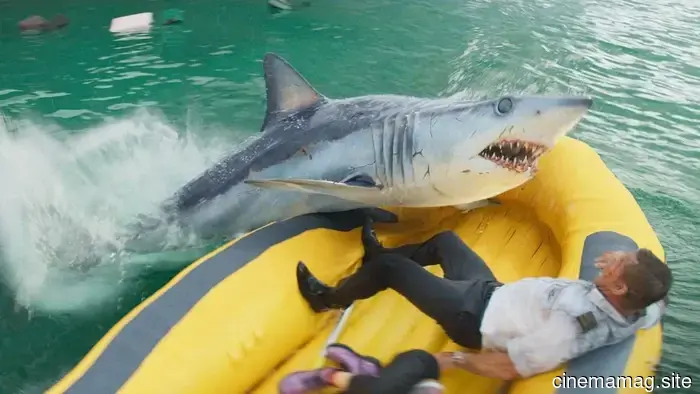
Deep Water Review: Renny Harlin Returns to Fundamentals in a Film Blending Airplane Catastrophe with Shark Thriller Elements
Returning to shark-infested waters a quarter-century after Deep Blue Sea became a staple on cable TV and streaming, Renny Harlin’s Deep Water seems to belong to a different era, for better or worse. Featuring a cast filled with simplistic yet earnestly portrayed archetypes and thrills delivered in a straightforward roller-coaster structure, this combination of an airplane disaster and shark thriller could easily fit into a late-night TV lineup and, aside from its overly polished digital finish, might be mistaken for a rediscovered artifact from the past. This nostalgic return to the disaster films of the 1970s has a certain modest appeal, boosted by Harlin’s brisk direction, despite lacking elements that leave a lasting impact.
Since Steven Spielberg landed in Martha’s Vineyard, no director has significantly reinvented the shark thriller genre. In his second attempt, Harlin is keenly aware of revisiting the classic elements of the subgenre. A whole act passes before we catch sight of any fins; however, we are introduced to a plethora of characters embarking on their doomed journey, and every cliché is utilized. We meet the troubled hero pilot (Aaron Eckhart), alongside the headstrong, older captain (Ben Kingsley); families who become separated; bickering passengers who must learn to collaborate for survival; unexpected romantic sparks; elderly travelers who must make a sacrifice; and, naturally, the obnoxious character (Angus Sampson) that we want to see get devoured. Each line hints at what lies ahead, and every quip is delivered with a knowing wink. It’s perplexing that this script, crafted by five writers (Pete Bridges, Shayne Armstrong, S.P. Krause, and Damien Power, with additional contributions from John Kim), hints more at behind-the-scenes disputes than any effort towards creating a touch of originality or depth.
Despite these clichés, which persist alongside Fernando Velázquez’s overly dramatic score featuring somber piano notes at emotionally charged moments, Harlin brings a vital energy with his swift direction. As chaos envelops the plane, the director unapologetically eliminates around 90% of the 257 passengers with graphic scenes of heads being bashed and bodies being crushed or sucked into the air, which may be a more favorable fate than what awaits them in the water. Essentially combining two films into one, Deep Water is crammed with enough characters that allow for quick cross-cutting between various action sequences. As the plane crashes and partitions into three segments in the water, editor Geoff Lamb (known for his horror editing in Talk to Me and Bring Her Back) skillfully ensures that each sequence reaches its peak before seamlessly transitioning to the next group in danger. This technique keeps viewers engaged, even though it sacrifices deeper connections to any individual character.
Deep Water serves as a somewhat forgettable summer film to kick off the season, likely to be overlooked by Memorial Day. However, if you're searching for a few jump scares and a quick adrenaline rush, it offers some straightforward entertainment. After a few years of cinematic drought with The Strangers sequels and lesser-known genre outings, Renny Harlin’s latest feels like a fitting return.
Deep Water debuts in theaters on Friday, May 1.
Other articles
 Stranger Things: Tales From '85 is set to return for its second season this fall.
Netflix has revealed that the Stranger Things universe will persist on the platform with the new animated series, Stranger Things: Tales from '85, which has already been renewed for a second season following the initial season...
Stranger Things: Tales From '85 is set to return for its second season this fall.
Netflix has revealed that the Stranger Things universe will persist on the platform with the new animated series, Stranger Things: Tales from '85, which has already been renewed for a second season following the initial season...
 Paul Reubens Shines in The Crown, Exploring Shadows and the Quest for Identity
Paul Reubens and Jasbir (JB) Singh Ghuman formed a friendship when the Pee-wee Herman actor watched Ghuman's 2010 movie Spork and reached out to praise it. Ghuman
Paul Reubens Shines in The Crown, Exploring Shadows and the Quest for Identity
Paul Reubens and Jasbir (JB) Singh Ghuman formed a friendship when the Pee-wee Herman actor watched Ghuman's 2010 movie Spork and reached out to praise it. Ghuman
 The Scarecrow is now part of Mezco Toyz’s Batman: The Animated Series One:12 Collective line with a new figure release.
Mezco Toyz has unveiled promotional images for its One:12 Collective Scarecrow figure, drawing inspiration from the villain's look in the classic Batman: The Animated Series. The collectible is…
The Scarecrow is now part of Mezco Toyz’s Batman: The Animated Series One:12 Collective line with a new figure release.
Mezco Toyz has unveiled promotional images for its One:12 Collective Scarecrow figure, drawing inspiration from the villain's look in the classic Batman: The Animated Series. The collectible is…
 Our 12 Top Movies Set in Ski Resorts
Here are our 12 favorite films set in ski resorts.
Our 12 Top Movies Set in Ski Resorts
Here are our 12 favorite films set in ski resorts.
 Jennifer Garner stars in the trailer for Peacock’s drama, The Five Star Weekend.
Peacock has released the initial trailer and images for The Five Star Weekend, which is an upcoming adaptation of Elin Hilderbrand’s novel of the same title. The drama series features Jennifer Garner in the role of Hollis…
Jennifer Garner stars in the trailer for Peacock’s drama, The Five Star Weekend.
Peacock has released the initial trailer and images for The Five Star Weekend, which is an upcoming adaptation of Elin Hilderbrand’s novel of the same title. The drama series features Jennifer Garner in the role of Hollis…
 Paul Reubens Shines in The Crown, Exploring Shadows and the Quest for Identity
Paul Reubens and Jasbir (JB) Singh Ghuman developed a friendship after the Pee-wee Herman actor reached out to Ghuman to praise his 2010 movie Spork. Ghuman
Paul Reubens Shines in The Crown, Exploring Shadows and the Quest for Identity
Paul Reubens and Jasbir (JB) Singh Ghuman developed a friendship after the Pee-wee Herman actor reached out to Ghuman to praise his 2010 movie Spork. Ghuman
Deep Water Review: Renny Harlin Returns to Fundamentals in a Film Blending Airplane Catastrophe with Shark Thriller Elements
Reentering shark-infested waters a quarter of a century after Deep Blue Sea became a staple on cable and streaming, Renny Harlin's Deep Water seems to belong to a different time, for better or worse. Featuring a cast filled with clichéd yet sincerely portrayed archetypes and delivering excitement in a straightforward roller-coaster style, this blend of airplane disaster and shark thriller could easily fit into a