
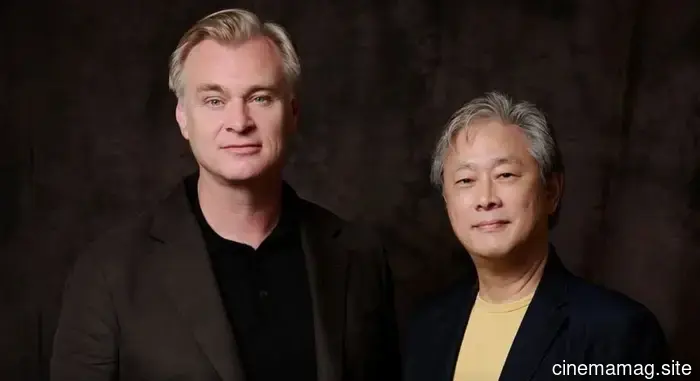
Christopher Nolan and Park Chan-wook Talk About The Odyssey, Illusions, and Cinematic Methods
As Christopher Nolan's The Odyssey achieves a career-high record as his most successful film, grossing $1.1 billion, the epic continues to debut in various countries globally. Another week brings another engaging discussion as he tours Asia. This time, Park Chan-wook, known for directing Oldboy and No Other Choice, conversed with Nolan, both expressing admiration for each other's work.
Park shared his favorite elements of the film, including the framing of the Trojan horse, the creative incorporation of the sound of Odysseus' bow being plucked into the score, and a notable violent moment. He also touched on the title card, the absence of gods, and more.
Below is an edited English translation of their conversation, followed by the full video.
Park Chan-wook: Welcome to Korea. Promoting a movie after its completion is an exhausting endeavor. While I cherish every aspect of directing, this is the one part I would prefer to avoid. How do you feel about it?
Christopher Nolan: I feel exactly the same.
I've been a huge fan of yours since I saw Memento. As films become larger, it’s rare and extremely challenging for them to improve, yet you've managed to do so throughout cinematic history.
Thank you. That means a lot coming from you. Beyond my deep respect for you and your work, it’s thrilling to hear that from a fellow director who understands the process so well.
I clearly recall my time filming The Sympathizer when I met Robert Downey Jr. He shared his exhilarating experience working with you on Oppenheimer, especially having your IMAX camera right in front of him. I can still picture the look on his face when he recounted that.
It’s a massive camera and quite noisy. When it’s right in front of an actor, they realize all eyes are on them, and they must truly immerse themselves in the moment. Collaborating with Robert was a tremendous thrill—a pleasure you know too, having worked with him yourself.
Regarding The Odyssey, I was completely entranced from the first scene. The wooden horse in the sea, the Trojan knights approaching... that opening was so beautiful and captivating that I wished those shots were significantly longer—perhaps even 10 minutes due to how deeply I was drawn in.
Thank you. It’s wonderful to hear that. That opening image was one I envisioned for about 20 years: “How would I depict the Trojan horse? How would I approach that?”
I became deeply intrigued by representing the horse differently than the conventional view, complete with wheels and easily brought into the city. For an audience aware of the trick, how do you present it?
To me, portraying it half-buried in the sand—as a fallen monument akin to the Statue of Liberty at the conclusion of the first Planet of the Apes—felt fitting. We see this monument being destroyed by waves. This framed the idea that it would be highly unlikely for this horse to return to the city filled with Greeks. It's an image, much like you, I've carried with me for years, wanting to realize it on film.
My recent project, No Other Choice, took two decades from when I first read the original book. Although I initially intended it as an American film, after spending a long time on the script, I concluded that producing it in Korea was far more beneficial for me. Similar to your experience, I hope you find that making The Odyssey now has resulted in something more fulfilling than your initial thoughts about directing it.
For No Other Choice, the defining image I retained for two decades was a depiction of a happily united family. That’s why the film begins with a father experiencing total joy with his family—and even his dogs—set against a Mozart horn concerto. That vision was there from the start and has remained consistent over the years.
Shifting an American narrative into a Korean context brought it to life for me. I'm proud of the film, and I believe that sometimes things turn out for the best. I’m pleased that I made The Odyssey when I did.
I’m curious about the adaptation since the story begins and concludes with the Trojan Horse. How did you decide on that structural choice?
For me, it became crucial to consider what matters to the audience, what visuals will stay with them, and what significance those images hold. Although the Trojan horse isn’t a central focus in the Odyssey—merely referenced in flashbacks—it serves as a potent cinematic symbol associated with Troy and the character who orchestrated its downfall.
I contemplated why you chose this image to open and conclude the film, recognizing how vital that decision was and that all elements must fit within it.
I interpreted your choice as emphasizing Odysseus's feelings of guilt regarding the cowardly tactic of using the horse as a weapon. Framing guilt, which diverges from Homer’s original tale, seemed to be a core element of your Odysseus, explaining your choice to bookend it.
That was indeed part of
Other articles
 Which star will triumph in 2026?
Based on the films of 2026, the cinema scene is dominated by a select few actors who are monopolizing the box office successes. But who will emerge victorious in 2026 and claim the title of star of the year? This year has seen an impressive box office performance...
Which star will triumph in 2026?
Based on the films of 2026, the cinema scene is dominated by a select few actors who are monopolizing the box office successes. But who will emerge victorious in 2026 and claim the title of star of the year? This year has seen an impressive box office performance...
 Which star will emerge victorious in 2026?
Based on the films of 2026, the cinema industry seems to be dominated by a select group of actors who are monopolizing the box office successes. However, who will ultimately emerge as the standout star of 2026? This year has seen a remarkable surge in box office…
Which star will emerge victorious in 2026?
Based on the films of 2026, the cinema industry seems to be dominated by a select group of actors who are monopolizing the box office successes. However, who will ultimately emerge as the standout star of 2026? This year has seen a remarkable surge in box office…
Christopher Nolan and Park Chan-wook Talk About The Odyssey, Illusions, and Cinematic Methods
As Christopher Nolan's The Odyssey achieves a career milestone with a record $1.1 billion in earnings, the epic continues to be released in various countries around the globe. With another week comes another engaging discussion from his tour in Asia. This time, Park Chan-wook, the director of Oldboy and No Other Choice, conversed with Nolan about the